Feature guide
Peptide Refrigerator With Lock: What to Look For Before You Buy
Written by the VIALYX™ team · Updated August 2026 · Roughly an 11 minute read
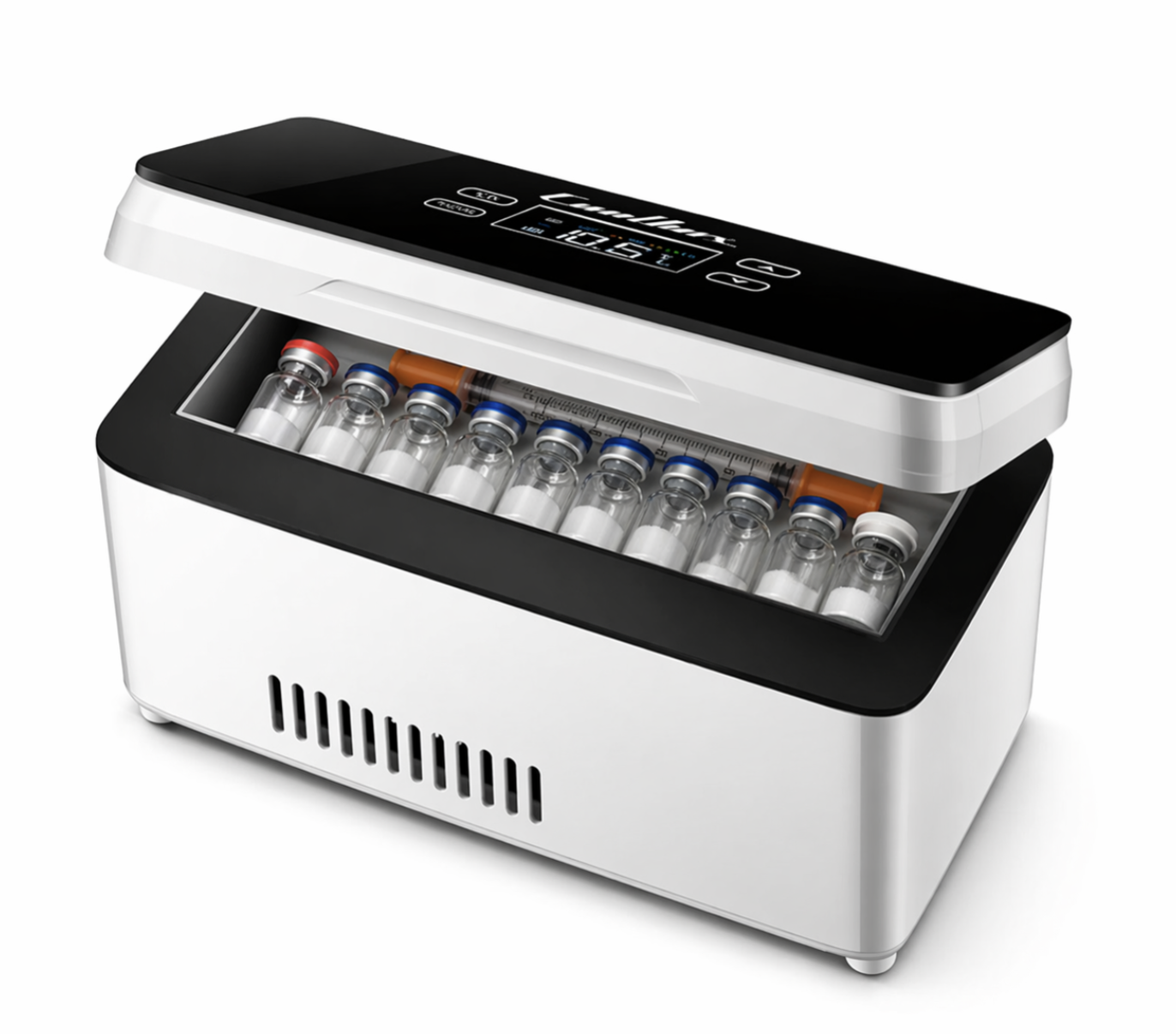
Most refrigerator features are about what happens inside the cabinet. A lock is the exception: it is entirely about people. It exists because someone opened a door who was not supposed to, or because you would rather that never became possible in the first place. That makes it a different kind of buying decision from anything else on a specification sheet, and one that deserves to be thought about in its own terms rather than added as a bullet point.
The trouble is that the word carries far more weight in a listing than in reality. A small catch on a compact appliance is described with the same vocabulary used for safes and controlled cabinets, and buyers understandably read more into it than the hardware supports. This guide is about closing that gap: what access control on a domestic refrigerator genuinely achieves, what it cannot, and how to work out whether you need it at all.
Two boundaries before we begin. Nothing here is medical advice and nothing here is a storage instruction; follow the guidance supplied with whatever you keep refrigerated. And VIALYX™ is a consumer refrigeration product for dedicated home storage — not a medical refrigerator, medical device or laboratory refrigerator — and we make no certification, regulatory or stability claims for it.
1. Why Would You Want a Peptide Refrigerator With a Lock?
Ask ten buyers and you get roughly four answers, and they call for quite different hardware.
Children in the house
This is the most common motivation by a distance, and the most reasonable. The concern is not theft; it is a curious three-year-old and an unsupervised minute. The requirement here is modest — anything that turns a pull into a deliberate action is usually enough — but it must be effortless to engage, because a childproofing measure that is inconvenient stops being used.
Shared households
Flatshares, house shares, family homes with teenagers, homes with regular visitors. The concern is not malice but ordinary curiosity and the human tendency to open a closed door. A lock here is mostly a social signal: it says this cabinet is not communal, and that message does more work than the mechanism does.
Peace of mind about tampering
Some buyers simply want to know that nothing has been moved. A lock does not prove that — most domestic mechanisms leave no evidence either way — but the psychological value of a closed loop is real, and it is a legitimate reason to spend a little more.
Cleaners, carers, trades and short lets
Where other people are routinely in your home without you, the goal is to remove a decision from them rather than to defeat them. A visible lock accomplishes that immediately and without any conversation.
2. What Does a Lock Actually Provide?
It is worth being precise, because the honest description is narrower than the marketing one and still perfectly useful.
It converts an easy action into a deliberate one
The main effect of a domestic lock is friction. Opening the cabinet stops being something that happens absent-mindedly and becomes something a person must decide to do, find a key for, and complete. Nearly all of the practical benefit lives in that change.
It communicates intent
A locked door is a statement that does not need repeating. In shared living situations that is often the entire function — a boundary made visible so it does not have to be negotiated again.
What it does not provide
It does not provide resistance to a determined attempt. Compact refrigerator bodies are thin panels with a flexible magnetic seal, and the door is rarely the strongest part of the assembly. Nor does a lock guarantee security in any general sense, or tell you whether anything inside was touched during a period when it was unlocked.
What it says about the inside of the cabinet
Nothing at all. A lock is hardware attached to a door. It is not evidence of temperature uniformity, sensor calibration, stability over time, or suitability for any particular product — and it does not make a refrigerator appropriate for medical, laboratory, pharmaceutical or regulated use. Those categories are defined by classification and documentation, never by a catch on a door.
3. Types of Access Control to Compare
"Lockable" covers several quite different arrangements, and the right one depends on which of the motivations above is actually yours.
Integrated keyed locks
A barrel fitted into the door or frame at manufacture. Simple, nothing to charge, nothing to forget — and entirely dependent on a small metal object that lives somewhere. Ask how many keys come with the unit and whether replacements can be obtained, because losing the last one is the failure mode that actually occurs.
Latches and child catches
A mechanical catch requiring a squeeze, a slide or two simultaneous actions. Not a lock in any meaningful sense, and often exactly right for a household whose only concern is small children. Cheap, immediate, nothing to lose, and it does not depend on remembering to lock anything.
Coded or electronic mechanisms
Keypads and electronic catches remove the key problem and introduce power, resets and forgotten codes. If you consider one, the questions worth asking are what happens when power is lost and how a code is recovered — that is where these arrangements differ most.
Aftermarket straps and cabinet locks
Adhesive straps and appliance locks fit almost anything and cost very little, which is genuinely attractive because it decouples the lock decision from the refrigerator decision. The caution is purely mechanical: nothing you add should hold the door away from the frame or distort the gasket. After fitting, check that the door still closes flush unaided.
Placement as access control
The most underrated option is not hardware. A unit in a study, a cupboard or a room that is routinely closed already controls access, sometimes better than a catch on a door in a hallway. It costs nothing and never gets forgotten.
4. Lock vs Temperature Monitoring vs Alarm
These three get grouped under "features" and answer completely unrelated questions. Keeping them separate prevents most of the disappointment in this category.
A lock answers: who can open it?
Physical access control. It governs people and says nothing whatsoever about conditions inside.
A display answers: what is it doing now?
A readout gives you a value when you look at it — useful, passive, and dependent on your presence. We cover what it does and does not demonstrate in the guide to a unit with a readout.
An alarm answers: should you be interrupted?
Alerting works when you are not present, which is precisely when a lock is doing nothing and a display is being read by nobody. The distinctions there are worked through in the alerting guide.
The practical rule: never let one of these imply another. A lockable unit may have no display. A unit with a fine display may have no alerting and no lock. Confirm each feature independently on the specification, because listings routinely bundle them under a single reassuring heading.
5. When a Lock May Be Useful
A lock earns its place when the answer to "who might open this?" is a specific person rather than a vague worry.
- Young children live in or regularly visit the home.
- The unit must stand in a shared or communal space rather than a private room.
- Cleaners, carers, trades or guests are routinely in the home unaccompanied.
- The household includes people who open closed things out of habit.
- You want a visible boundary in a flatshare without having a conversation about it.
- The unit will occasionally travel or be left somewhere you do not control.
In each of those cases the lock is solving a defined problem. That is the test — if you can name the scenario, the feature is probably worth paying for.
6. When a Lock May Not Be Necessary
It is equally worth saying plainly that many buyers do not need one, and paying for it narrows the shortlist for no gain.
- You live alone, or with adults who have no interest in the cabinet.
- The unit will stand in a private room that is already effectively controlled.
- There are no children in the household and none visit.
- You would realistically never engage it after the first week.
- The better-suited unit for your space and items simply does not offer one.
- Your actual concern is conditions inside, which a lock does not address at all.
That last point deserves emphasis. A surprising number of people searching for a lock are really expressing a general wish for control, and would be better served by an arrangement they can see into. If that describes you, the general selection guide is a more useful starting point than this one.
7. What to Compare Before Buying
Once you have decided a lock matters, these are the differences that show up in ownership. The table describes how these products are typically designed and documented; it is not a test result, it describes no specific model, and it makes no claim about how any contents behave.
| Factor | Why it matters | What to verify |
|---|---|---|
| Lock mechanism | A latch, a keyed barrel and a coded entry behave very differently in daily use | The mechanism named specifically, not just “lockable” |
| Integration | A built-in lock respects the door design; an add-on may not | Whether it is factory-fitted or a separately supplied accessory |
| Effect on the seal | Anything that holds the door proud of the frame changes how it closes | Photographs of the closed door with the mechanism engaged |
| Key or code handling | Lost keys and forgotten codes are the usual failure, not forced entry | How many keys are supplied and whether replacements exist |
| Failure behaviour | What happens if the mechanism jams decides how bad a bad day gets | Whether an override or replacement route is documented |
| One-handed use | A lock that is awkward stops being engaged within a fortnight | How the mechanism is operated while holding something |
| Placement in the room | A lock is one part of access control; position and reach matter more | Footprint, door swing and whether the unit can be sited out of reach |
| Separation from monitoring | A lock says nothing about conditions inside the cabinet | Display, alerting and lock listed as independent features |
If a listing cannot answer the right-hand column, you are not comparing locks. You are comparing an adjective.
8. How to Evaluate a Product Listing
Named hardware, not adjectives
"Secure", "lockable" and "protected" are not mechanisms. Look for a specific description of what is fitted and how it operates, and treat the absence of that description as an answer in itself.
Do not read a lock out of a photograph
A recess, a badge, a handle detail or a decorative escutcheon are not confirmation. Product images are frequently reused across variants and models, and inferring hardware from pixels is the most common way buyers end up with something they did not order.
Accessory or fitted?
Some pages describe a lock that ships in the box as an add-on rather than something built into the door. Both can be fine, but they are different products and the page should say which.
The absent answers
Keys supplied, replacement route, failure behaviour, effect on the door seal. Gaps in those four predict most post-purchase regret. For a sense of how a page reads when it is written to be checked rather than skimmed, see the current offer page.
9. Questions to Ask Before Ordering
Send these to a seller before you buy. How specifically they reply tells you as much as the answers.
- What type of lock is fitted, and is it integrated or an accessory?
- How many keys or credentials are supplied with the unit?
- Are replacement keys available, and can a code be reset?
- What is the procedure if the mechanism jams or fails?
- Does engaging the lock change how the door sits against the frame?
- Can the lock be operated one-handed while carrying something?
- Is the lock related in any way to alerting or monitoring on this model?
- Which rows of your specification table are confirmed, and which are provisional?
10. Common Mistakes When Choosing a Lockable Refrigerator
- Buying for a lock without ever deciding what it is protecting against.
- Assuming a lockable appliance offers meaningful resistance to a determined attempt.
- Fitting an aftermarket strap that holds the door slightly open and never noticing.
- Choosing a locking model with a cramped interior over a better-laid-out one without.
- Treating a lock as a childproofing plan rather than one part of one.
- Never establishing how replacement keys are obtained until one goes missing.
- Reading a lock as though it implied alerting, monitoring or any temperature claim.
- Inferring a lock from a photograph of a handle or a badge on a door.
The thread running through these is the same one that runs through most feature-led purchases: a single visible attribute is allowed to stand in for the whole decision, and the things you touch daily get decided by accident.
11. VIALYX™ Peptide Fridge
The VIALYX™ Peptide Fridge is a compact consumer refrigerator made for people who want refrigerated items kept apart from food, in their own dedicated unit, in a place they choose. Its design intent is separation and layout — items standing where you left them, in a cabinet that is not opened by somebody looking for lunch. It is offered in two sizes.
On access control we will be explicit, because this is exactly the claim that is made loosely across this market. Our published specification table includes a door-lock row that is currently unconfirmed. We therefore do not state that VIALYX™ has a door lock, keyed lock, combination lock, keypad, child lock, electronic or biometric lock, access codes, restricted access, tamper protection, a security alarm, or any form of remote access control. We also do not infer a lock from any product photograph, and we do not infer one from any other feature — access control is independent of everything else on a specification.
If a lock is a firm requirement, treat it as something to resolve before ordering rather than something to assume. The current product information does not confirm one, so verify the current specifications at the time of purchase and ask us directly if the row you need is still open. We would rather leave a specification visibly blank than fill it with something plausible, and we make no certification, regulatory, medical-device, laboratory or stability claims for the product.
12. How to Compare Your Options
Build a short grid and resist expanding it: what mechanism is fitted and by whom, what happens when a key or code goes missing, whether engaging it changes how the door closes, and the delivered total. Four columns will settle most shortlists.
Then weigh the lock against the things you handle every day — interior layout, door behaviour, footprint, where the unit can realistically stand. A locking cabinet that forces you to stack items is a worse purchase than an open one that does not, and if you are still deciding between a purpose -built unit and a general compact fridge, the side-by-side comparison covers that ground properly.
Last, remember the option that costs nothing: choosing where the unit lives. Placement is access control, it never gets forgotten, and it works while you are asleep. When you are ready to compare the current arrangements, you can view the online purchase page.
13. Buyer Checklist
- 01I can state in one sentence who or what the lock is meant to stop.
- 02The listing names the actual mechanism rather than saying “lockable”.
- 03I know whether the lock is factory-integrated or a supplied accessory.
- 04There is a photograph of the door closed with the mechanism in place.
- 05I know how many keys or credentials come with the unit.
- 06Replacement keys or a code-reset route are documented.
- 07I know what happens if the mechanism jams or a key is lost.
- 08The mechanism can be operated with one hand, in a hurry.
- 09Engaging it does not hold the door away from the frame.
- 10I have a realistic view of whether I would lock it every single time.
- 11Placement, reach and stability have been considered, not just the catch.
- 12I have not read the lock as evidence about temperature behaviour.
- 13Display and alerting, if I want them, are listed as separate features.
- 14The interior suits my items upright in a single layer, lock or no lock.
- 15The delivered total, return window and warranty length are written in numbers.
- 16Every specification I am relying on appears on the page rather than in my assumptions.
14. Frequently Asked Questions
Does a lock make a refrigerator secure?
It makes it harder to open casually, which is a real and useful property, but it is not security in any strong sense. Compact appliance locks are generally deterrents against convenience rather than barriers against determined effort, and the cabinet around them is thin material with a flexible seal. Think of a lock as something that stops an idle hand and creates a deliberate step, not as something that resists an attempt.
Is a built-in lock better than adding one myself?
Not automatically. An integrated lock is tidier, cannot be removed by accident and does not interfere with the seal. An aftermarket strap or cabinet lock is cheaper, can be fitted to whichever unit best suits your space, and is replaceable. The risk with add-ons is anything that puts pressure on the door or gasket, so choose fittings that do not change how the door closes.
Will a lock help with childproofing?
It can help, and it is the most common reason buyers in this category want one. But childproofing is about the whole arrangement — where the unit stands, whether it can be tipped, whether a cable is reachable — not about a single catch. A lock is one element of that, and it only works if it is actually engaged every time, which is a habit question rather than a hardware question.
Does a lock affect how the door seals or how the unit runs?
A well-integrated lock should not, because it is designed around the door it is fitted to. Aftermarket hardware is where problems appear: anything that holds the door slightly open, deforms the gasket or blocks the hinge changes how the cabinet behaves. If you add something, check afterwards that the door still closes flush on its own without being pushed.
Should I choose a locking model over one with a better interior layout?
Rarely. A lock is used at a moment; the interior is used every day. If a lockable unit forces you to stack items, or does not fit the space you have, you will feel that constantly and the lock only occasionally. Where both are available, take both. Where you must choose, be honest about how often the lock would actually be engaged.
Is a lock relevant to how well a refrigerator holds temperature?
No. Physical access control and temperature management are completely separate considerations, and a locking mechanism is no evidence of uniformity, calibration, stability or suitability for any particular product. A lock also does not make a refrigerator appropriate for medical, laboratory, pharmaceutical or regulated use. What is appropriate for anything you keep refrigerated comes from the guidance supplied with that item or from the pharmacy or supplier who provided it.
15. Conclusion
A lock on a compact refrigerator is a modest, honest feature that does one job well: it turns an easy action into a deliberate one, and it makes a boundary visible without anyone having to say it out loud. For households with small children, shared space, or people coming and going, that is worth having and worth paying a little for.
Just keep the claim the right size. A lock is not security, not tamper evidence, and not a statement about anything happening inside the cabinet — physical access control and temperature management are entirely separate considerations, and no catch on a door makes an appliance suitable for medical, laboratory or regulated use. Compare the mechanism, the keys, the failure behaviour and the effect on the door; weigh it against the layout and the space you actually have; and where a specification is not confirmed in writing, treat it as unconfirmed rather than likely.
VIALYX™ is a consumer refrigeration product for dedicated home storage. It is not a medical refrigerator, medical device or laboratory equipment, and no certification, regulatory or stability claims are made for it. No lock, access-control method, alerting feature, temperature range, capacity or other specification is stated here as confirmed. Verify the current product specifications before purchasing. This article is general buying guidance, not medical advice, and contains no storage instructions.