Comparison
VIALYX™ vs Mini Fridge for Peptides: Which Should You Buy?
Written by the VIALYX™ team · Updated August 2026 · Roughly an 11 minute read
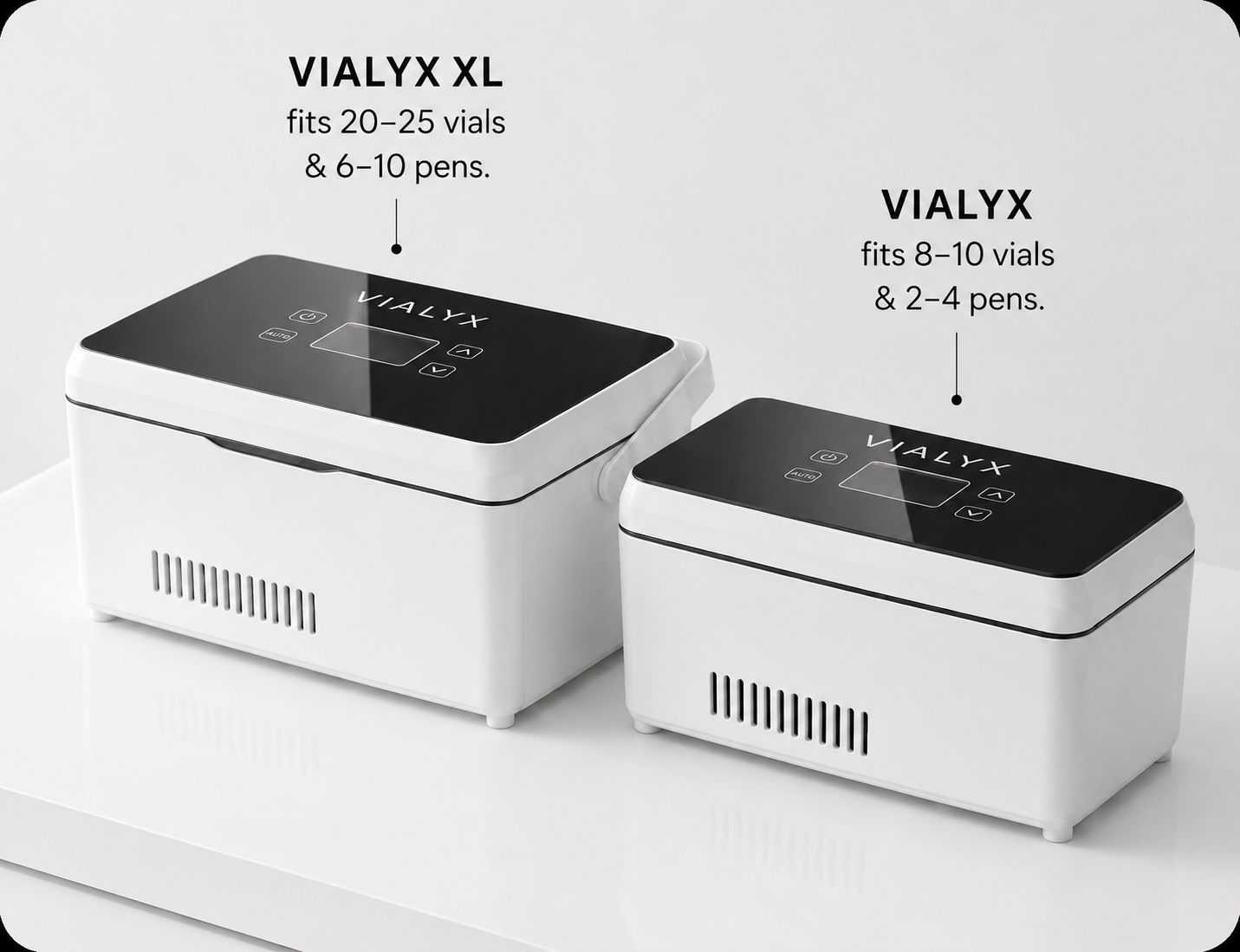
This is the comparison most people are actually running in their heads. On one side there is a compact fridge that costs very little and is available almost everywhere. On the other there is a product built for one job, sold by one company, at a higher price. Somewhere between those two sits the right answer for your situation, and it is genuinely not the same answer for everybody.
We sell one of the two options in this comparison, so read it with that in mind — and hold us to it. Nothing below claims that a mini fridge is unsafe, that everyone needs a dedicated unit, or that our product outperforms anything on a metric we have not tested. What follows is the set of distinctions that reliably decide the question, written so you can apply them to any two units, ours included.
One factual boundary first. VIALYX™ is a consumer refrigeration product. It is not a medical refrigerator, a medical device or laboratory equipment, and we publish no certification, regulatory or stability claims for it. Nothing here is medical advice: follow whatever storage guidance came with the items you keep refrigerated, then choose equipment that makes following it easy.
1. VIALYX™ vs Mini Fridge: The Short Answer
If you already own a compact fridge that is not being used for food, you are comfortable adding your own thermometer, and budget is the constraint that decides purchases in your house — use it. That is a reasonable position and it is not a compromise you need talking out of.
If you want the temperature visible without opening the door, you want your items standing upright and findable rather than rolling behind a can rack, and you want the storage separate from household food and household traffic, a purpose-built unit is what you are describing. The premium buys layout, visibility and separation — not a promise about the contents.
Everything after this section is the reasoning behind that split, factor by factor, so you can check whether your situation lands on one side or the other. There is also a full VIALYX™ vs mini fridge comparison on the main site if you want the condensed product-side version of the same question.
2. What Is a Generic Mini Fridge?
A generic mini fridge is a compact, general-purpose cooler designed around drinks and snacks. That design brief shows up everywhere in the product: tall shelf gaps sized for bottles, wire racks shaped for cans, a door bin for the same, and a thermostat expressed as a numbered dial rather than a temperature. It is a genuinely good product for what it was built to do, and the low price reflects a mature, high-volume category rather than corner-cutting.
Its strengths are real. It is cheap, immediately available, endlessly repurposable, and if your needs change next year it becomes a drinks fridge for the spare room instead of a redundant appliance. For a buyer who values flexibility and a low upfront cost above all else, that combination is hard to argue with — and our guide to choosing a compact unit exists precisely because plenty of people make that choice deliberately.
Its weaknesses are equally structural. Because it was designed around cans, small upright containers tend to lie down, roll, or end up stacked behind something taller. Because the thermostat is a dial, you have no way to confirm the interior state without adding a thermometer. And because it is general-purpose, it invites general-purpose use — which in a shared household means somebody else's lunch, and the door being opened for reasons unrelated to you.
3. What Is the VIALYX™ Peptide Fridge?
VIALYX™ is a compact refrigerator designed around one use rather than many. Two things follow from that brief. The interior is arranged so small upright containers stand in a visible single layer instead of being stacked or laid down, and the temperature is shown on a front-panel display so checking it costs a glance rather than an opened door.
What we deliberately do not do is fill in a specification we have not confirmed. Figures that are still being verified are left visibly open on the product page rather than replaced with a plausible number, which is unusual in this category and occasionally costs us a sale to a listing that simply made one up. Verify the current product specifications before purchasing — including anything about capacity, dimensions, temperature behaviour, noise, energy use or warranty terms — and take those from the product page rather than from this article, because a guide is the wrong place to freeze numbers that can change.
It is also worth being clear about what a dedicated unit does not do. It does not guarantee the condition of anything you put inside it, and no appliance from any brand can. What it can do is remove the small daily frictions — invisibility, disorder, shared access — that make careful storage harder than it needs to be.
4. Side-by-Side Comparison
The table below compares the two categories on the factors that change a buying decision. It describes how these products are typically designed and sold; it is not a test result, and it makes no claim about how any particular contents behave at any temperature.
| Factor | Generic mini fridge | VIALYX™ peptide fridge |
|---|---|---|
| Intended use | General-purpose cold storage for whatever needs it | One category of small items, stored separately |
| Footprint | Wide range, from desk-sized to under-counter | Compact; confirm the published dimensions before you measure a spot |
| Organisation | Open shelves or can racks; you supply the order | Interior arranged so small upright containers stay visible |
| Monitoring | Usually a numbered dial with nothing to read back | Front-panel temperature display |
| Everyday convenience | Depends on how tidy you keep it and who else opens it | Find-and-lift without rearranging neighbours |
| Placement | Anywhere with a socket and clearance | Anywhere with a socket and clearance; sized for a smaller spot |
| Purchase considerations | Often a marketplace listing; seller varies in permanence | Bought direct, with one company answering for it |
| Flexibility | Repurposable for drinks, lunches, anything cold | Deliberately single-purpose |
5. Size and Footprint
Compact fridges span an enormous range, from something that sits on a desk to something that fills an under-counter gap. That breadth is an advantage for the mini fridge category: whatever your space, something in it fits. It is also a trap, because litres are a volume figure and tell you nothing about whether your items fit the shape of the interior.
Measure the intended spot first — width, depth, height, plus the clearance the manufacturer asks for and a door that can open fully without meeting a wall or a chair. The most common regret in this category is not a unit that fails to fit; it is a unit that fits and then cannot be opened comfortably in the place it fits into. Do that measurement before you compare any two products, and check the published dimensions for whichever unit you are considering rather than assuming a category norm.
6. Storage and Organization
This is where the two categories separate most visibly. A drinks-oriented interior is built vertically for bottles and horizontally for cans, so small upright containers either lie down or get stacked. A second layer sounds harmless until you are searching for a specific label with the door open, moving three items to reach the fourth.
A purpose-built interior aims at the opposite behaviour: one layer, everything visible from the front, each item liftable without disturbing its neighbours. Whether that is worth paying for depends entirely on how many items you keep and how often you reach in. Two items, twice a month — the difference is cosmetic. A dozen items handled daily — the difference is the whole reason to buy.
Sharing the shelf
Separation is the other half of organisation, and it is the argument people underrate. A dedicated unit means nothing else is competing for the space, nobody else has a reason to open it, and the door stays shut except when you open it. In a single-occupant home that matters less. In a shared household it is often the deciding factor by itself.
7. Temperature Monitoring
A numbered dial communicates a setting. A readable display communicates a condition. That is the whole distinction, and it is the one feature difference in this comparison that is not a matter of taste.
It is also the gap that is cheapest to close on the mini fridge side. A small digital thermometer with an external readout costs very little and gives a general-purpose fridge most of the visibility a dedicated unit has built in. What it adds is a step — placing it, reading it, replacing a battery — and a slightly more cluttered interior. If you are the kind of buyer who will genuinely do that, the monitoring argument for a dedicated unit weakens considerably, and you should weigh the remaining factors instead. The longer treatment lives in our dedicated versus regular refrigerator comparison.
8. Everyday Convenience
Convenience is not one feature; it is the accumulation of small ones. Does the door latch itself, or does it depend on how firmly you pushed? Can you see what you need without moving anything? Do you know the temperature without opening it? Is there an interior light that helps rather than dazzles?
None of these decide a purchase on their own, and all of them decide how you feel about the purchase after a month. A general-purpose fridge can score well here if it happens to suit your items; a purpose-built one is designed to score well by default. Neither guarantees it, which is why the interior photographs on any listing are worth more study than the headline.
9. Placement
Both options need the same three things: a socket, clearance around the vents, and a level surface that is not next to a radiator or in direct sun. Beyond that, placement is mostly about the room.
A bedroom rewards a unit whose compressor cycle you can sleep through — worth checking noise behaviour for any specific model rather than trusting a category assumption. A hallway or utility space tolerates more noise but may be colder in winter, which affects how hard any fridge works. A kitchen is convenient but reintroduces the shared-space problem a dedicated unit was bought to solve. A garage swings furthest in ambient temperature and is the least predictable choice for either category.
10. Cost and Buying Considerations
A generic mini fridge is cheaper, sometimes dramatically. That is a genuine advantage and not something to explain away. What is worth comparing honestly is the delivered total rather than the headline: shipping, an adapter if the plug does not match your country, and a separate thermometer if you intend to add one. Those additions rarely close the gap entirely, but they narrow it more than buyers expect.
The second consideration is who you are buying from. Marketplace listings for compact fridges are often anonymous and impermanent, which matters only when something goes wrong — at which point it matters a lot. Buying direct means one company is accountable for the product, the warranty and the reply to your email. Whichever route you take, get the return window, the warranty length and the delivered total in writing before paying. Our guide to ordering online covers that verification in detail.
11. When a Mini Fridge May Make Sense
A general-purpose compact fridge is the better buy when any of the following describe you. You already own one that is not being used for food, so the marginal cost of using it is zero. Upfront cost is the binding constraint rather than a preference you would trade away. You want an appliance that can be repurposed for drinks or lunches if your needs change. You store few enough items that organisation is not a daily issue. Or you are willing to add your own thermometer and check it yourself, which is a small habit that closes the largest single gap.
If two or more of those apply, buying a dedicated unit is buying convenience you may not use. That is a legitimate thing to decline.
12. When a Dedicated Peptide Fridge May Make Sense
A purpose-built unit is the better buy when the opposite set applies. You want the storage physically separate from household food and household traffic. You handle enough items often enough that a visible single-layer interior saves you real time. You want the temperature readable without opening the door and would rather not manage a separate thermometer. You want one identifiable company answering for the product after the sale. Or the space you have is small and specific enough that a unit sized for it beats a generic one that technically fits.
If several of those describe you, the premium is buying something you will notice weekly rather than a badge. Our broader buyer's guide to dedicated units goes through the feature weighting in more depth.
13. What to Verify Before Buying Either Option
The verification list does not change much between categories, which is itself informative. Confirm the external dimensions and compare them against a spot you have physically measured, door swing included. Confirm whether the unit reads back an interior temperature or only shows a setting. Confirm the plug supplied for your country, and whether an adapter is expected on your side. Confirm the delivered total, the return period in days, the warranty length and which company honours a claim.
Then read the specification table for what it does not say. A table where every row is conveniently complete, on a product nobody has reviewed, is less trustworthy than one that visibly marks some rows as still to be confirmed. For VIALYX™ specifically: verify the current product specifications before purchasing, and treat this article as reasoning rather than as a source of figures.
14. VIALYX™ Peptide Fridge
Where VIALYX™ fits in this decision is narrow and worth stating plainly. It is for the buyer who has concluded that dedicated, organised, visible storage is worth paying for, and who would rather buy from a company that has to answer for the product than from a listing that may not exist next year.
It is not for the buyer whose priority is the lowest possible upfront cost, or who wants one appliance that can do several jobs over its life. Those are real priorities and a general-purpose fridge serves them better. We would rather say that here than have you discover it after ordering.
Everything documented about the unit — the gallery, the feature list, and the specification table including the rows still marked as pending — lives on the VIALYX™ Peptide Fridge page.
15. Which Option Is Right for You?
Answer three questions honestly. First: will anyone other than you open this fridge? If yes, separation is worth more to you than the price difference suggests. Second: how often do you reach in? Daily handling makes interior layout a recurring cost; occasional handling makes it cosmetic. Third: will you actually add and read a thermometer if the unit does not have a display? Most people who say yes do not, and knowing which kind you are is more useful than any specification.
Two or three answers pointing at separation, frequency and visibility means the dedicated unit earns its price. Two or three pointing the other way means a compact general-purpose fridge is the right call and you should spend the difference on something else.
16. Buyer Checklist
Run this against whichever option you are leaning towards. It applies to both categories, which is the point — a good purchase in either one passes the same tests.
- 01I measured the intended spot including door swing and the clearance the maker asks for.
- 02I counted what I actually store in a typical month, rather than guessing.
- 03Everything I store would sit upright in a single layer in the interior shown.
- 04I know whether the unit reads back an interior temperature or only a setting.
- 05If it is a dial, I have priced a separate thermometer into the comparison.
- 06I know who else in the household would open this fridge, and how often.
- 07The room I plan to put it in tolerates whatever noise a compressor makes there.
- 08The plug supplied suits my country, with no adapter assumed on my side.
- 09I am comparing delivered totals, not headline prices.
- 10The return window and warranty length are written down in numbers.
- 11There is a named company behind the listing and a contact route that replies.
- 12Any specification I am relying on is confirmed on the page rather than implied.
- 13No part of my decision rests on a medical, regulatory or stability claim.
17. Frequently Asked Questions
Is a mini fridge good enough, or do I need a dedicated unit?
Both can hold a cold interior. The honest difference is in how the space is arranged, whether you can read the temperature without opening the door, and whether the contents share the shelf with food. If those three points do not bother you, a compact fridge you already own is a legitimate answer and spending more buys you convenience rather than necessity. If any of them bothers you weekly, a purpose-built interior is the thing you are actually paying for.
Does VIALYX™ hold a steadier temperature than a mini fridge?
We do not publish a comparative stability claim, because we have not run a like-for-like test against arbitrary third-party units and would not present marketing copy as one. What is different by design is visibility and layout: a readable interior figure and an interior arranged for small upright containers. Verify the current product specifications before purchasing, and treat any seller — us included — who quotes an unsourced accuracy figure with scepticism.
Can I just keep a thermometer in a mini fridge instead?
Yes, and for many buyers that closes most of the gap for the price of a coffee. A small digital thermometer with an external display turns a numbered dial into something you can actually read. What it does not fix is layout, door traffic from other household users, or the fact that the shelf is shared. It is a good, cheap first move if you already own the fridge.
Which one makes more sense if I move house or travel often?
Judge it on weight, footprint and whether the plug configuration matches where you are going, not on the category name. A small unit of either type moves more easily than a large one. If moving between countries is part of the picture, the plug supplied and the voltage it expects matter more than any interior feature, so confirm that on the product page before ordering rather than assuming an adapter will do.
Is VIALYX™ a medical or laboratory refrigerator?
No. VIALYX™ is a consumer refrigeration product intended for dedicated home storage. It is not a medical refrigerator, a medical device or laboratory equipment, and we make no regulatory, certification or stability claims for it. If a purchase decision of yours depends on a regulated classification, a consumer product from any brand is the wrong category to be shopping in.
What would make you say a mini fridge is the better buy?
When you already own one that is not being used for food, when budget is the deciding constraint rather than a preference, when you are happy to add your own thermometer, or when you want a unit that can be repurposed for drinks or lunches later. Flexibility and a low upfront cost are real advantages, and a guide that pretends otherwise is selling rather than advising.
18. Conclusion
There is no universal winner here, and a comparison that produces one is usually working backwards from a preferred conclusion. A generic mini fridge wins on price, availability and flexibility. A dedicated unit wins on layout, visibility and separation. Which set of advantages matters more is a property of your household, not of the products.
What is worth insisting on either way is specificity: measured dimensions, a stated return window, a named warranty holder, and a clear answer about whether you can read the temperature. Buyers who check those four things rarely regret the purchase, whichever category they land in.
If you have landed on the dedicated side, current sizes, plug options and buying arrangements are set out on the purchase page rather than here, because those change and a guide should not promise them.
VIALYX™ is a consumer refrigeration product for dedicated home storage. It is not a medical refrigerator, medical device or laboratory equipment, and no certification, regulatory or stability claims are made for it. Nothing in this article is medical advice. Verify the current product specifications before purchasing.