Feature guide
Peptide Refrigerator With Temperature Display: What to Look For
Written by the VIALYX™ team · Updated August 2026 · Roughly a 10 minute read
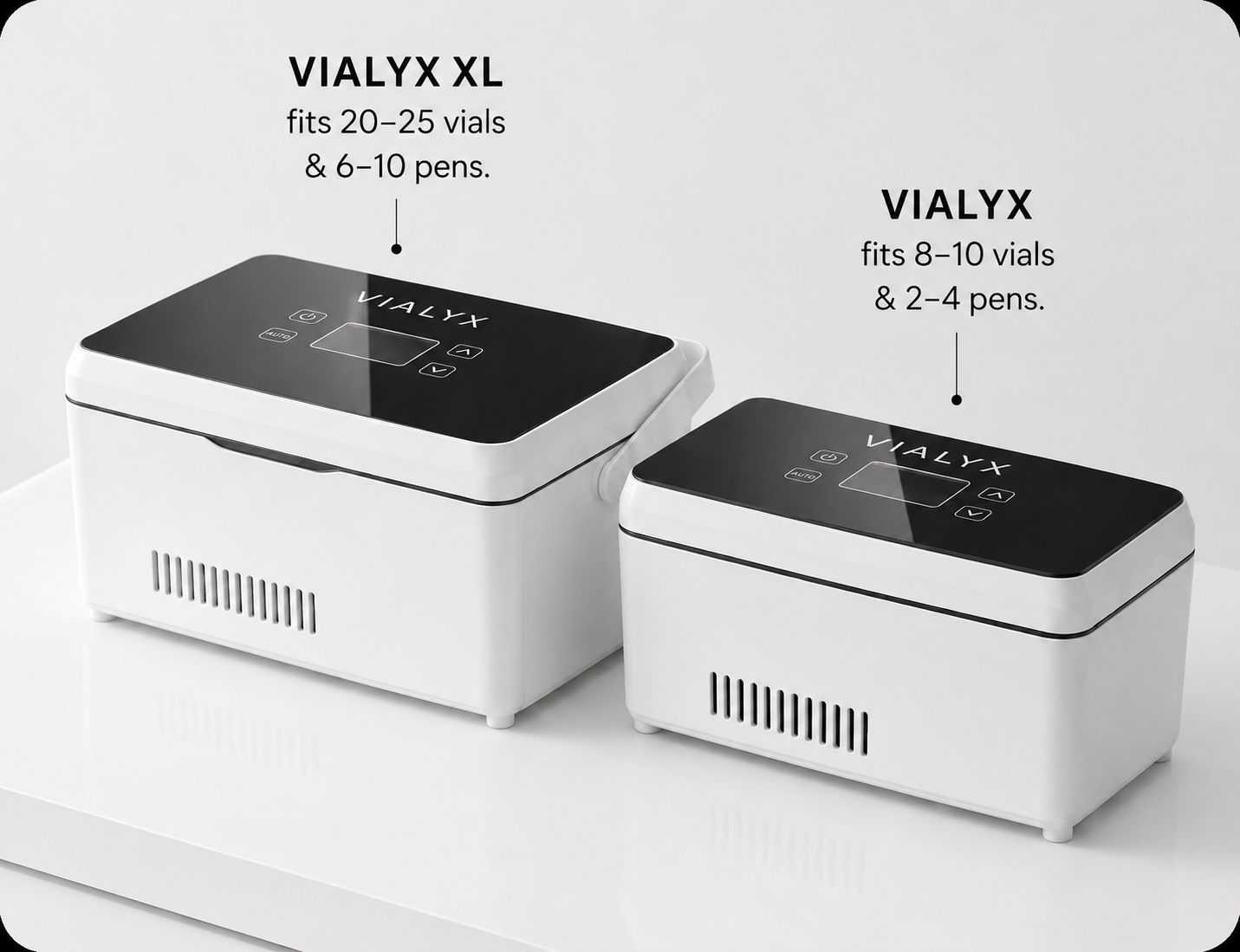
Searching specifically for a refrigerator with a temperature display is a sign of a buyer thinking clearly. It means you have already worked out that a dial marked one to seven tells you what you asked for and nothing about what you got. A screen closes that gap, and it is one of the few features in this category that changes behaviour rather than appearance.
It is also one of the most oversold. A number on a panel is frequently presented as though it settles the question of storage quality, and it does not. This guide is about getting the useful part of the feature without buying the implied part: what a readout genuinely tells you, what it cannot prove, how to judge one on a listing, and which other features deserve to sit alongside it in your decision.
Two boundaries before we start. Nothing here is medical advice and nothing here is a storage instruction — follow the guidance supplied with whatever you keep refrigerated. And VIALYX™ is a consumer refrigeration product, not a medical refrigerator, medical device or laboratory equipment; we publish no certification, regulatory or stability claims for it.
1. Why Buyers Look for a Temperature Display
The motivation is almost always the same, and it is a good one: people dislike storing something they care about in a box they cannot see into. A dial gives you a setting and asks for trust. A readout gives you a fact you can check on the way past, and that difference is felt daily rather than theoretically.
There is a second, quieter reason. A visible figure lets you notice change. If a unit normally reads within a familiar band and one morning it does not, you have information you would otherwise have acquired by accident, later, and with less to do about it. Noticing early is most of the practical value of any monitoring feature.
And a third: it removes the door as part of the check. Without a screen, confirming the interior means opening it — which is the one action that reliably changes what you were trying to measure. A panel you can read with the door shut breaks that loop.
2. What a Temperature Display Actually Tells You
It tells you what one sensor, in one position, reported at one moment. That is a genuinely useful fact and it is also a narrow one. It is not an average of the cabinet, not a guarantee of evenness from top to bottom, and not evidence that the sensor is calibrated against any reference.
One point, not a volume
Air inside any refrigerator is not uniform. It moves, it stratifies, and it is affected by how full the interior is and how recently the door was opened. A single reading describes its own neighbourhood. Where the sensor sits therefore matters as much as the number it produces, which is why it is worth asking a seller and worth noting when nobody will say.
A moment, not a history
A display is a snapshot. Unless a product explicitly offers logging, it holds no record, so a figure that looks reassuring now says nothing about the hour you were out. Buyers who want a history should look for logging as a separate, named feature rather than expecting a screen to imply it.
A reading, not a verdict
Most importantly, a number is not a judgement about suitability. Whether any particular figure is appropriate for a particular product is determined by that product's own guidance, not by the appliance. A fridge can only report; deciding is elsewhere.
3. Temperature Display vs Temperature Monitoring
These get used interchangeably in listings and they are not the same thing. A display shows a value now. Monitoring is a system: something observes over time, retains what it saw, and ideally tells you when something falls outside a range you defined. A screen is the visible end of monitoring, not monitoring itself.
The practical consequence is that you should decide which of the two you actually want before comparing products. If a glance in the morning is enough, a display is sufficient and paying for more is optional. If you want to know about an event you were not present for, you are shopping for logging or alerts, and those must be listed by name — a product with a fine readout may offer neither.
Worth separating too: a digital thermostat and a temperature readout are different features that share a word. A unit can be digitally controlled, with tidy buttons and a numeric setpoint, and still never show you what the interior is doing. Read the specification rather than the adjective.
4. Features to Compare Before Buying
The table below is the comparison worth running once you have shortlisted units that all claim a display. It describes how these products are typically designed and documented; it is not a test result, and it makes no claim about how any contents behave at any temperature.
| Feature | Why it matters | What to verify |
|---|---|---|
| What the screen shows | A setpoint echoes your instruction; a sensor reading reports a condition | Which of the two is displayed, stated explicitly |
| Where the sensor sits | A figure describes the air where the sensor is, not the whole interior | Whether the sensor location is documented at all |
| Display placement | A readout you must open the door to see defeats its own purpose | Photographs showing the screen with the door closed |
| Readability | Digit size, contrast and glare decide whether you check it in passing | An unedited photograph rather than a render |
| Resolution and units | Whole degrees versus tenths changes what you can actually observe | Stated increments, and whether units can be switched |
| Adjustment range | A screen is only useful if the setpoint moves in meaningful steps | Published adjustment range and step size |
| Alarms and logging | Separate features entirely; a display does not imply either | Each one listed individually, not bundled under “smart” |
| Backlight behaviour | A permanently lit panel in a bedroom becomes a nightlight | Whether the light is always on, timed, or switchable |
5. Display Location and Readability
A readout is only as good as your ability to read it without effort, and this is where listings quietly disappoint. A panel mounted inside the cabinet, or on the inner door frame, requires the one action the feature was meant to avoid. Establish from photographs that the screen is visible with the door closed.
Then think about your actual room. Digit height decides whether you can read it standing rather than crouching, which matters if the unit sits low. Contrast and glare decide whether a bright window washes it out at the time of day you usually check. A permanently lit panel is fine in a hallway and an irritation in a bedroom, so look for whether the backlight can be dimmed, timed or switched off.
Photographs beat renders
A render can show any panel in perfect legibility. A photograph taken in an ordinary room, at an ordinary angle, shows you what you will actually get. If a listing has no honest photograph of the display lit, that absence is itself a piece of information.
6. What Temperature Information Should You Verify?
Four things, in this order. First, whether the figure shown is a sensor reading or the setpoint — this is the single most consequential ambiguity in the category. Second, the increment: whole degrees and tenths give you very different visibility into small changes. Third, the adjustable range and its step size, because a display without meaningful control is only half a feature. Fourth, whether the sensor position is documented anywhere.
If a listing does not answer these, that is not automatically disqualifying — but it should be answered before payment rather than after. And where a specification is not confirmed for a product, including ours, the correct response is the same: verify the current product specifications before purchasing, and do not infer a feature from a neighbouring one.
7. Why a Display Alone Is Not the Whole Buying Decision
It is easy to let one feature carry a purchase, especially when it was the search term. But a unit with an excellent readout and an interior built for cans will still leave your items lying down, stacked and hidden — and you will notice that far more often than you notice the screen.
Weigh the display alongside interior geometry, whether the door latches and seals without your attention, the footprint against a spot you have physically measured, and noise if the unit shares a room with a bed. A display makes a good unit easier to live with; it does not make a poorly suited one appropriate. Our wider guide to weighing features on a dedicated unit covers that balance in more depth.
8. Dedicated Peptide Refrigerator vs Generic Mini Fridge
On this specific feature the categories usually differ. Compact drinks fridges are typically sold with a numbered dial and no readout, because their design brief never required one. Units marketed for dedicated storage more often include a screen, since visibility is part of what the category is selling.
That is a tendency rather than a rule, and it is cheap to close from the other direction: a small probe thermometer with an external readout gives a general-purpose fridge most of the same visibility for very little money. If you already own a compact unit, that is a sensible first move, and our notes on choosing a compact fridge assume exactly that route. If you are still deciding between the two categories overall, the side-by-side of the two approaches is the better starting point than this feature alone.
9. What to Check on a Product Listing
Read the specification table rather than the headline. You want the display described in terms of what it shows and in what increments, not as an adjective. You want at least one photograph of the panel lit, with the door closed, in a real room. And you want the rest of the specification to look measured rather than generic — phrasing that appears verbatim across unrelated compact fridges suggests nobody measured this one.
Note also what a listing claims beyond the feature. Words like clinical, pharmaceutical or laboratory-grade are used loosely in consumer appliance copy, and no consumer appliance can guarantee the condition of its contents. A page implying otherwise is asserting more than it can support, which is worth weighing against everything else it says.
10. Questions to Ask Before Buying
Send these to any seller you are close to ordering from. The answers matter, and so does whether anyone replies at all.
- Does the screen show the current interior reading, the setpoint, or both?
- Where in the cabinet is the sensor placed?
- In what increments does the reading change, and can I switch units?
- What is the adjustable range, and in what steps?
- Is the display visible with the door closed, in normal room lighting?
- Is the backlight always on, and can it be turned off?
- Are there any alarms, and what conditions trigger them?
- Which rows of your specification table are confirmed, and which are provisional?
11. Common Mistakes When Choosing a Refrigerator With a Temperature Display
- Treating the presence of a screen as the whole specification, and skipping interior layout entirely.
- Assuming a displayed number is a calibrated measurement of the whole cabinet.
- Buying a unit whose readout is inside the door, so checking it changes the thing being checked.
- Reading “digital” in a title as a promise of a temperature readout rather than a digital thermostat.
- Paying for logging or connectivity that will never be opened after the first week.
- Ignoring a permanently lit panel in a room somebody sleeps in.
- Comparing headline prices instead of delivered totals once shipping and plug options are added.
- Accepting a specification that appears verbatim on unrelated compact fridges as though it were measured.
12. VIALYX™ Peptide Fridge
Here is the honest position, which is more useful to you than a confident one. Our published specification table includes a temperature display row, and that row has not yet been confirmed in writing by our supplier. So this article does not state that VIALYX™ has a temperature display. Verify the current product specifications before purchasing.
That policy is deliberate and it applies across the table: temperature behaviour, capacity, dimensions, weight, power, noise, locking, warranty and certifications are published only once we can stand behind them, and left visibly open until then. It occasionally costs us a sale to a listing that simply filled every row in. We think a buyer who can tell a confirmed figure from an estimate is better served.
What we will describe is the intent: VIALYX™ is a compact refrigerator built for one use rather than many, so that items are stored separately from household food and household door traffic. Everything documented — the gallery, the feature list and the specification table with its pending rows shown as pending — is on the VIALYX™ Peptide Fridge page.
13. How to Compare Your Options
Put the shortlist side by side on four columns only: what the screen shows, whether you can read it with the door closed, whether your items fit upright in a single layer, and the delivered total. Most decisions resolve on that grid, and adding columns tends to add confidence rather than information.
Then apply a tiebreaker that has nothing to do with features: which seller answered a question clearly. A unit you can ask about, from a company that replies, is worth more than a marginally better specification behind an unanswered contact form. If you want to see how the current arrangements compare, the current offer page and the online purchase page set them out together.
14. Buyer Checklist
- 01The listing states whether the screen shows a sensor reading or the setpoint.
- 02There is a photograph of the display with the door closed.
- 03The digits are legible from where the unit would actually stand.
- 04I know the increment the reading and the setpoint move in.
- 05The adjustment range is published, not implied.
- 06Alarms, logging and connectivity are listed individually if I want them.
- 07I know whether the backlight is constant, timed or switchable.
- 08The sensor position is documented, or I have accepted that it is not.
- 09I have not treated the displayed figure as evidence of uniformity or calibration.
- 10The interior layout suits my items standing upright in a single layer.
- 11I measured the intended spot including door swing and vent clearance.
- 12The plug supplied suits my country with no adapter assumed on my side.
- 13The delivered total, return window and warranty length are written in numbers.
- 14Any specification I am relying on is confirmed on the page rather than inferred.
- 15No part of my decision rests on a medical, regulatory or stability claim.
15. Frequently Asked Questions
Does a temperature display mean the fridge holds a steady temperature?
No. A display reports a reading from one sensor, at one place, at one moment. Steadiness over time and evenness across the interior are separate properties that a single number cannot demonstrate. A readout is genuinely useful — it converts guesswork into information you can act on — but treat it as a window rather than a warranty, and do not read a stable-looking figure as proof of anything beyond what the sensor saw.
What is the difference between the number shown and the number I set?
Many compact units display the setpoint — the target you asked for — while others display what the sensor currently reads. Those can differ, particularly just after the door has been open. It is worth establishing which one a product shows before you buy, because a screen that only echoes your own instruction tells you nothing about the interior. If a listing does not say, ask.
Is an external thermometer as good as a built-in display?
For visibility, often yes, and it costs very little. A small probe thermometer with the readout outside the door gives you an interior figure without opening anything. What it adds is a device to place, a battery to replace and one more thing inside the cabinet. What a built-in screen adds is that none of that is your problem. Neither approach is more accurate by definition.
Should I pay more for alarms, logging or app connectivity?
Only if you would use them. An alert for a door left open or a reading outside a band is useful to some buyers and noise to others; logging matters if you want a history rather than a snapshot. These are separate features from a display, so confirm each one individually on the product page rather than assuming a screen implies them.
Does VIALYX™ have a temperature display?
Our published specification table lists a temperature display row that has not yet been confirmed in writing by our supplier, so we do not state it as a feature here. We would rather leave a row visibly open than fill it with a plausible answer. Verify the current product specifications before purchasing, and take the confirmed rows from the product page rather than from this guide.
Can a display tell me whether my items are being stored correctly?
No, and no appliance feature can. A readout tells you about the air near a sensor; it says nothing about whether that suits any particular product. Storage requirements come from the guidance supplied with the items themselves or from the pharmacy or supplier who provided them. This article is not medical advice and does not issue storage instructions.
16. Conclusion
A temperature display is one of the genuinely worthwhile features in this category, because it replaces trust with information at almost no cost in complexity. Ask for it, and prefer a unit that shows a reading you can see with the door closed over one that echoes your own setpoint from behind the glass.
Just keep it in proportion. A number on a panel is a reading, not a proof of uniformity, calibration, stability or suitability for anything in particular. Judge it alongside interior layout, door behaviour, footprint and the seller's willingness to be specific — and where a specification is not confirmed, treat it as unconfirmed rather than likely.
VIALYX™ is a consumer refrigeration product for dedicated home storage. It is not a medical refrigerator, medical device or laboratory equipment, and no certification, regulatory or stability claims are made for it. No temperature display, temperature range, capacity or other specification is stated here as confirmed. Verify the current product specifications before purchasing. Nothing in this article is medical advice or a storage instruction.