Feature guide
Peptide Refrigerator With Temperature Alarm: What to Look For
Written by the VIALYX™ team · Updated August 2026 · Roughly an 11 minute read
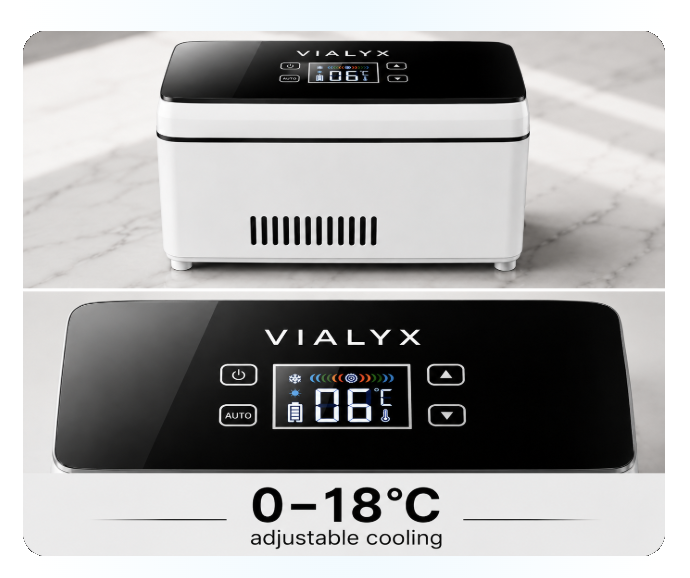
An alarm is a different kind of feature from almost everything else on a refrigerator listing. Capacity, shelving and finish describe the unit while you are looking at it. An alarm only matters when you are not looking — its entire job is to interrupt you at a moment you had not planned to think about the cabinet at all. That is why buyers search for it specifically, and it is also why the word gets stretched further in marketing copy than almost any other.
This guide treats the alarm as the subject rather than as a bullet point. What one actually does, how it differs from a screen and from monitoring, which characteristics separate a useful alert from a nuisance, and — the part most listings skip — what an alarm cannot tell you no matter how well it is implemented.
Two boundaries first. Nothing here is medical advice and nothing here is a storage instruction; follow the guidance supplied with whatever you keep refrigerated. And VIALYX™ is a consumer refrigeration product for dedicated home storage — not a medical refrigerator, medical device or laboratory refrigerator — and we publish no certification, regulatory or stability claims for it.
1. Why Buyers Look for a Temperature Alarm
The reasoning behind the search is usually sound and rarely stated outright: a person who has thought about refrigeration for more than five minutes realises that the risk is not the moment they are standing in front of the unit. It is the eleven hours overnight, the weekend away, the door that did not quite catch on the way past with an armful of shopping. Watching cannot cover those. Being told might.
There is also a psychological component worth naming, because it drives purchases. An alarm converts an open-ended worry into a delegated one. Instead of remembering to check, you have arranged for something to speak up. Whether that arrangement actually holds depends on details covered further down, but the appeal is genuine rather than irrational.
The third reason is the most practical. The single most common real-world failure in a compact fridge is not a compressor dying dramatically; it is a door left ajar. That is exactly the event a door alarm exists to catch, and it is the reason a modest local buzzer often delivers more value in practice than an elaborate networked alerting stack.
2. What a Temperature Alarm Actually Does
Mechanically, an alarm is a rule attached to a sensor. Something reads a value, compares it to a limit, and if the comparison fails for long enough, an output is triggered — a buzzer, a flashing indicator, an icon on a panel, occasionally a message somewhere else. That is the whole of it. Every meaningful difference between products lives in the specifics of that sentence.
It reports a crossing, not a condition
An alarm fires when a boundary is crossed. It says nothing about the territory on either side. A reading that sits just inside a limit for a week produces silence identical to a reading sitting in the middle of the band, because the rule only knows about the line.
It acts on one point of measurement
Whatever the alarm knows, it learned from a sensor in one position. If that sensor is behind an interior wall near the cooling element and your items sit near the door, the two are describing different microclimates. Neither figure is wrong; they are answers to different questions.
It requires someone to receive it
An alert that nobody hears has not done anything. This sounds obvious and is routinely overlooked when buyers imagine an alarm working while they are at the office, in a product whose alerting is a small buzzer inside a spare room.
3. Temperature Display vs Monitoring vs Alarm
These three are sold as though they were one feature with three names, and confusing them is the single most common reason buyers end up disappointed. They sit in a sequence, and each one adds something the previous one does not have.
Display: information on demand
A screen shows a value when you look at it. It is passive and it depends entirely on your presence and attention. Useful, cheap, and covered in more depth in our guide to a refrigerator with a readout.
Monitoring: information over time
Monitoring implies retention. Something observes continuously and keeps a record, so you can ask later what happened earlier. A display without logging holds no history at all; the previous hour is simply gone. If a history is what you want, look for logging as a separately named feature.
Alarm: information pushed to you
An alarm inverts the relationship. Rather than you querying the unit, the unit interrupts you. That is the only one of the three that works when you are not thinking about the fridge — but note that it does not imply the other two. A product can alert without ever showing a number, and can show a number without ever alerting. Confirm each independently on the specification.
4. What Alarm Features Should You Compare?
Once you have shortlisted units that all claim alerting, the differences below are what separate them. The table describes how these products are typically designed and documented. It is not a test result, it describes no specific model, and it makes no claim about how any contents behave at any temperature.
| Feature | Why it matters | What to verify |
|---|---|---|
| Trigger conditions | High-temperature, low-temperature and door-open alerts are separate behaviours | Each condition named individually, not bundled under “alarm” |
| Threshold adjustability | A fixed band far from your setpoint either never fires or never stops | Whether limits are user-set, and in what increments |
| Trigger delay | Without a delay, ordinary door openings produce constant false alerts | Whether a grace period exists and if it can be changed |
| Alert type | Audible, visual or both decides whether it works at night or across a room | Stated loudness behaviour and what the panel does visually |
| Mute and reset | An alarm you cannot silence gets unplugged, which removes it permanently | How it is acknowledged and whether muting is temporary or permanent |
| Sensor position | An alert describes the air at the sensor, not the whole interior | Whether the sensor location is documented at all |
| Behaviour on power loss | The event most worth hearing about can also disable the alerting | Whether any independent power supports the alert circuit |
| Remote notification | App, Wi-Fi or SMS alerting is a different product class with its own costs | Named connectivity, account requirements and any subscription |
If a listing answers fewer than half of the right-hand column, you are not comparing alarms. You are comparing the word.
5. Alarm Thresholds and What to Verify
A threshold is the line the rule watches, and it decides whether an alarm becomes something you rely on or something you switch off. Two questions cover most of it: where is the line, and who chose it?
Fixed versus adjustable
Manufacturer-set limits are simpler and require nothing of you, which suits buyers who would never configure anything. The risk is mismatch: a band chosen for the general market may sit awkwardly relative to how you intend to run the unit. Adjustable limits solve that and introduce a responsibility — a badly chosen setting is now yours.
Increment and resolution
If limits are adjustable, ask in what steps. Coarse increments can force you to pick between a line that fires too eagerly and one that barely fires. This is the kind of detail that never appears in a headline and always appears in daily experience.
Delay before triggering
Any usable alarm needs some tolerance for normal life. Opening the door changes the reading almost immediately; without a grace period, routine use produces routine alarms, and routine alarms get disabled. Ask whether a delay exists and whether it can be adjusted.
Confirmed rather than assumed
Whatever the answers, they should come from the seller in writing. Numbers copied between compact fridge listings circulate widely and get repeated without measurement. Where a figure is not confirmed for the specific model you are buying, treat it as unconfirmed rather than as probably right.
6. Audible and Visual Alerts
How an alarm expresses itself is not a minor detail; it determines whether it survives in your home.
Audible
Sound travels and demands attention, which is the point, and it is also the reason audible alerts get muted permanently in bedrooms, studios and small flats. If the unit will live near where someone sleeps, ask how insistent the sound is and whether it repeats indefinitely.
Visual
A flashing panel or coloured indicator is unobtrusive and only works if someone looks. As a secondary channel it is excellent — it tells you an event occurred and may still be occurring, after the sound has been silenced. As the sole channel it is closer to a display than to an alarm.
Muting, acknowledging and resetting
The most important alerting question is the least glamorous: how do you make it stop, and what happens afterwards? An alert that can only be ended by unplugging the appliance is a design that removes itself from service. Prefer behaviour where a mute is temporary and the condition remains visible until it clears.
Remote notification
Phone alerts are a separate product class. They involve connectivity, an account, sometimes a subscription, and a dependency on your network being up at the moment of the event. If that is what you are shopping for, insist it is named explicitly. The word alarm on its own never implies it.
7. What an Alarm Does Not Prove
This is the section that matters most, because alarms attract more implied meaning than any other feature in the category.
It does not prove uniformity
An alarm reads one point. Air inside any refrigerator stratifies and moves, and conditions differ between the door shelf and the back wall. Silence at the sensor is not a statement about the rest of the interior.
It does not prove calibration
A rule comparing a reading to a limit is only as meaningful as the reading. Unless a seller states how a sensor is verified against a reference, the alarm inherits whatever error the sensor carries — quietly, and with the appearance of precision.
It does not prove stability
Nothing about an alerting feature demonstrates that a unit holds conditions steadily. Alarms are exception handlers; they describe the edges of behaviour, not the behaviour itself.
It does not prove suitability
Most importantly, an alarm cannot tell you that a refrigerator is appropriate for a particular product. That question is answered by the guidance supplied with the items themselves, or by the pharmacy or supplier who provided them. An appliance can alert; it cannot approve.
And a quiet alarm is not a record. Absence of an alert means no watched condition crossed a line at one point, as far as the system could tell. It is not a log, not a guarantee, and not evidence that anything was fine.
8. Dedicated Peptide Refrigerator vs Generic Mini Fridge
Alerting shows up in both categories, and the difference is less about capability than about documentation and framing.
Generic compact fridges are enormously varied. Some include door alarms or temperature alerts; many do not; and listings are frequently unclear about which. The upside is choice and price. The cost is that you may spend real effort establishing what a specific unit actually does — a broader trade-off we work through in the compact fridge selection guide.
Units marketed for dedicated storage tend to be described in the vocabulary buyers in this category use, which usually means a clearer specification page and a seller who expects questions about sensors and alerts. That is a communication advantage rather than a physical one, and it should not be mistaken for a regulatory or performance claim. The full comparison of approaches sits in our side-by-side write-up.
There is also a third route that neither category owns: keep the appliance decision simple and add a standalone alarm thermometer positioned exactly where your items sit. For a lot of buyers that combination is more informative than a built-in sensor in an undisclosed location.
9. What to Check on a Product Listing
Listings are optimised for scanning, so read them adversarially. The useful signal is not what is claimed but how specifically it is claimed.
Named conditions
Look for the individual triggers — door open, temperature above a limit, temperature below a limit — rather than a single bullet reading "alarm function". A vague noun usually means the writer did not have the details either.
Photographs over renders
An unedited photograph of the front panel tells you where an indicator sits and whether it is visible with the door closed. Renders show what a designer intended and are frequently reused across unrelated models.
Recycled specification blocks
If the same paragraph appears verbatim on several unrelated compact fridges, it is a template rather than a description. Treat those numbers as marketing text, not measurement.
The absent answers
Note what is missing: sensor location, power-loss behaviour, mute behaviour, adjustability. Gaps in those four are the most predictable sources of post-purchase surprise. If you want to see how a clearly structured page reads by comparison, the current offer page is written to be checked rather than skimmed.
10. Questions to Ask Before Buying
Send these to a seller before ordering. A company that answers them plainly is telling you something about the purchase that no specification sheet can.
- Which conditions raise an alert — high temperature, low temperature, door open, or others?
- Are the alarm thresholds adjustable, and in what steps?
- Is there a delay before an alert triggers, and can it be changed?
- Is the alert audible, visual, or both, and how is it acknowledged?
- Where is the sensor that the alarm reads from?
- What happens to the alarm if mains power is interrupted?
- Is there any remote notification, and does it require an account or subscription?
- Which rows of your specification table are confirmed, and which are provisional?
11. Common Mistakes When Choosing a Refrigerator With an Alarm
- Reading the presence of a temperature display as proof that an alarm exists.
- Assuming “alarm” means a phone notification when it means a buzzer in the room.
- Buying a unit with fixed thresholds that sit nowhere near the setpoint intended.
- Ignoring the door-open case, which is the alert most likely to fire in real life.
- Choosing a model with no mute, then disabling the alarm entirely after a week of nuisance beeps.
- Never asking what the alerting does during a power cut.
- Letting one alerting feature outrank interior layout, footprint and door behaviour in the decision.
- Treating a quiet alarm as a record that conditions were appropriate the whole time.
The pattern running through all of them is the same: letting one feature stand in for the whole decision. An alarm is a useful component of a setup. It is not the setup.
12. VIALYX™ Peptide Fridge
The VIALYX™ Peptide Fridge is a compact consumer refrigerator built for people who would rather keep refrigerated items in their own dedicated unit than share a shelf with groceries. It is offered in two sizes, and the intent behind it is separation and layout — items standing where you left them, in a cabinet nobody else opens looking for milk.
On alerting specifically, we will be direct, because this is exactly the kind of claim that gets made loosely across this market. Temperature-alarm functionality is not confirmed in our current published product information. We therefore do not state that VIALYX™ has a temperature alarm, audible or visual alerts, adjustable alarm thresholds, high- or low-temperature alarms, a door alarm, notifications, remote alerting, Wi-Fi, SMS or app alerts, or data logging. Our specification table also carries a temperature display row that remains unconfirmed, and we do not infer alerting from a display in any case — those are separate features and one never implies the other.
If an alarm is a firm requirement for you, treat it as a question to resolve before ordering rather than an assumption to carry into the purchase. Verify the current product specifications on the product page at the time you buy, and ask us directly if a row you need is not stated there. We would rather leave a specification visibly open than fill it with something plausible, and we make no certification, regulatory, medical-device, laboratory or stability claims for the product.
13. How to Compare Your Options
Reduce the shortlist to a grid with four columns and resist adding more: which alert conditions are named, whether thresholds and delay are adjustable, how the alert reaches you and how you stop it, and the delivered total. Most decisions resolve there, and additional columns tend to add confidence rather than information.
Then step back and weigh the alarm against the features you will actually touch every day — interior layout, door behaviour, footprint, noise where the unit will stand. An excellent alarm on a cabinet that does not fit your items or your space is a poor purchase, a point the general selection guide works through in more depth.
Finally, apply a tiebreaker with nothing to do with features: which seller answered a specific question specifically. If you want to see how the present arrangements line up, you can view the online purchase page.
14. Buyer Checklist
- 01The listing names each alarm condition separately rather than saying “alarm function”.
- 02I know whether thresholds are fixed by the manufacturer or set by me.
- 03I know whether a delay exists before an alert fires after a door opening.
- 04The alert type is described: audible, visual, or both.
- 05I know how to silence an alert and whether muting is temporary.
- 06The sensor position is documented, or I have accepted that it is not.
- 07I have asked what the alarm does during a power interruption.
- 08Remote or app notification is listed by name if I need it, not inferred.
- 09I have not read a temperature display as implying an alarm.
- 10I have not treated the alarm as evidence of uniformity, calibration or stability.
- 11The interior layout suits my items standing upright without stacking.
- 12I measured the intended location including door swing and ventilation clearance.
- 13The plug type suits my country with no adapter assumed on my side.
- 14The delivered total, return window and warranty length are written in numbers.
- 15Every specification I am relying on appears on the page rather than in my assumptions.
15. Frequently Asked Questions
If the alarm never sounds, does that mean everything has been fine?
Not necessarily. Silence only means no condition the alarm was watching for crossed the threshold it was set to, at the point the sensor sits. A slow drift that stays inside the band, an uneven interior, or a sensor placed away from where your items are can all pass without a sound. Treat quiet as the absence of a triggered rule, not as a certificate.
Will an alarm reach me if I am not in the room?
Only if the product explicitly offers remote alerting, and most compact units do not. A buzzer and a flashing panel are local by design — they alert whoever is nearby. If being told while you are out matters to you, that is a connectivity feature with its own hardware, account and network requirements, and it must be listed by name rather than inferred from the word alarm.
What happens to an alarm during a power cut?
That depends entirely on whether the unit has any independent power for its alerting circuit, and many do not, which means the one event you would most want to hear about is the one that can silence the alerting. It is a fair and specific question to put to a seller before ordering, and the answer should be in writing rather than assumed.
Can I set my own alarm thresholds?
Some products allow it and others ship with fixed limits chosen by the manufacturer. The difference matters, because a fixed band that sits far from where you intend to run the cabinet will either never fire or fire constantly. Ask whether limits are adjustable, in what increments, and whether there is a delay before an alert triggers.
Is a standalone alarm thermometer a reasonable alternative?
For many buyers, yes. An inexpensive probe unit with its own alert can be placed exactly where your items sit, which is arguably better positioning than a built-in sensor you cannot move. The trade-offs are batteries, one more object in the cabinet, and a device that can be knocked or ignored. Neither approach is inherently more trustworthy.
Does an alarm make a refrigerator suitable for storing my items?
No. An alarm is an alerting feature attached to an appliance; it is not evidence of temperature uniformity, sensor calibration, long-term stability, or fitness for any particular product. What is appropriate for anything you keep refrigerated comes from the guidance supplied with that item or from the pharmacy or supplier who provided it. Nothing in this guide is medical advice or a storage instruction.
16. Conclusion
An alarm is worth wanting. It is the only feature in this category that does anything while you are asleep or out, and the humblest version of it — a buzzer for a door left open — probably prevents more real problems than any elaborate alternative. If you have been searching for one specifically, your instinct is a good one.
Keep it in proportion all the same. An alarm is an alerting feature attached to an appliance. It is not proof of temperature uniformity, sensor calibration, long-term stability or suitability for any particular product, and silence is not a record. Compare the specifics — conditions, thresholds, delay, alert type, mute behaviour, power-loss behaviour — judge them alongside layout and footprint, and where something is not confirmed in writing, treat it as unconfirmed.
VIALYX™ is a consumer refrigeration product for dedicated home storage. It is not a medical refrigerator, medical device or laboratory equipment, and no certification, regulatory or stability claims are made for it. No temperature alarm, alert method, threshold, temperature range, capacity or other specification is stated here as confirmed. Verify the current product specifications before purchasing. This article is general buying guidance, not medical advice, and contains no storage instructions.