Storage basics
How to Transport Peptides Safely
Written by the VIALYX™ team · Updated August 2026 · Roughly a 17 minute read
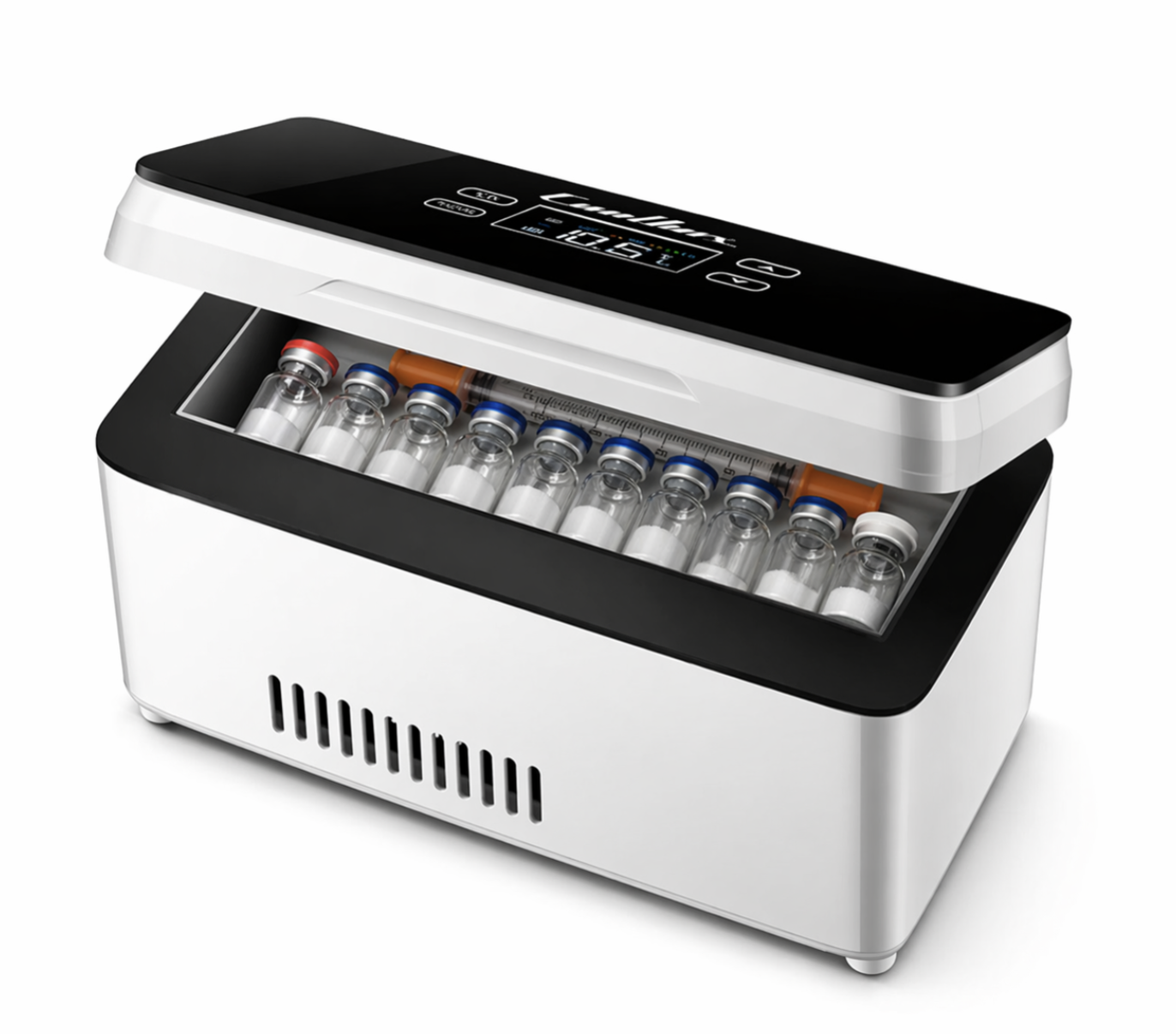
Transport is the part of a routine that people think about last and improvise most. At home, everything has a place. The shelf is the same shelf it was yesterday, the container lives where it always lives, and the documentation is in the drawer beside it. The moment a journey begins, all of that structure disappears and gets replaced by a bag, a series of unfamiliar rooms and a schedule that other people control. That is the real problem with transport, and it is an organisational problem long before it is anything else.
This article is about that organisational problem specifically. It is not a general storage guide, not a guide to whether refrigeration is required, and not an attempt to work out how long something can sit outside its normal arrangement. Those are separate questions with separate answers, several of which are covered elsewhere on this site. What follows is about planning a journey, packing for it, keeping things organised and protected while you are in motion, handling the awkward middle parts, arriving somewhere unfamiliar, and getting home again with everything you left with.
One boundary applies throughout. There are no transport times, maximum durations, temperatures, shelf lives, degradation timelines, study references, certifications or product specifications anywhere in this article, because those are properties of individual products and are supplied with them. No method described here guarantees anything about a product’s condition, and nobody who has not seen your product is in a position to promise that it does. Transport recommendations depend on the specific product, and the manufacturer’s instructions are what govern them. Nothing here is medical, pharmaceutical or laboratory advice.
The short version
Read the documentation supplied with your product before you plan, not at the door. Plan the journey door to door, including delays and the return leg. Pack once, into one labelled container, with the original packaging and paperwork. Keep it with you, keep it closed, and handle it as little as the journey allows. Where the documentation does not answer a question about your specific journey, ask the pharmacy, clinic or supplier who provided the product rather than reasoning it out from an article.
Why Transport Requires Planning Rather Than Improvisation
Almost every transport story that goes wrong has the same shape: the plan covered the part of the journey the person was thinking about, and something happened in a part they were not. The flight was considered; the two hours in the terminal beforehand were not. The drive was considered; the stop for lunch was not. The hotel was considered; the afternoon between checking out and the train was not. Journeys are made of stages, and the weak stage is almost never the obvious one.
- A journey is made of stages, and the stage that catches people out is rarely the one they were thinking about.
- Decisions made at the door are made in a hurry, with a bag half-packed and a taxi waiting.
- Delays, connections and detours are normal, so a plan that only works on schedule is not really a plan.
- Other people handle bags during travel, and they do not know what is inside them.
- Destinations are unfamiliar, and the arrangement you rely on at home may not exist there.
- The return leg is planned by almost nobody, and it is a whole journey in its own right.
The test of a plan
A plan you can say out loud in one sentence is a plan. “It travels in the labelled container, in my hand luggage, with the paperwork, and goes straight into the arranged place when I arrive” is a sentence. “I’ll sort it out at the airport” is not. If your plan needs several conditional branches to describe, it will not survive a delayed connection, because you will be improvising the branches at exactly the moment you are least able to think clearly.
Understanding the Manufacturer’s Instructions Before You Travel
Everything else in this article is organisation. This section is the part that actually decides things. Whatever the documentation supplied with your product says about how it should be kept is the instruction that applies, and it applies on a train exactly as it applies in your kitchen. Travelling is not a category that suspends it, and no amount of careful packing substitutes for reading it.
- The storage section as supplied, whether it appears on the carton, an insert, a label or supplier paperwork.
- Whether transport, journeys or time away from normal storage are mentioned at all.
- Whether a separate instruction applies once the product has been opened or prepared.
- Whether packaging, light, moisture or handling are addressed alongside anything else.
- Any dating or record-keeping you are asked to observe, which does not pause because you are travelling.
- The gaps — the questions the documentation simply does not answer, which belong to the supplier rather than to you.
Pay particular attention to the last item on that list. Documentation is often silent about transport, and silence is not permission — it is an unanswered question. The correct response to a gap is to write the question down and send it to the pharmacy, clinic or supplier who provided the product, which is easy to do a week before travelling and awkward to do the night before. If you want the broader picture of how these instructions work and why they differ from one product to the next, the peptide storage guide covers the whole framework rather than the travelling slice of it.
Preparing Before You Leave Home
Preparation is not packing. Packing is the last ten minutes of a process that should have started days earlier. The preparation stage is where you confirm the rules that apply to your particular journey, decide what the arrangement will be, and assemble everything you need so that packing becomes an act of moving objects rather than making choices.
- Read the documentation early enough that a question can still be asked and answered.
- Confirm the rules of every airline, rail operator, carrier or country involved in the journey, well before departure.
- Decide the door-to-door plan in one sentence: where the item travels, in what, with whom, and what happens on arrival.
- Assemble the packaging, labels, documentation and any equipment the night before, not on the morning itself.
- Decide what you will need during the journey and what will stay untouched until you arrive.
- Tell whoever you are travelling with what is in the bag and that it stays with you.
Organising Refrigerated Products During Transport
The organising principle for transport is simple and worth stating in one line: everything travels as one unit. Not as several items in a bag, not with the paperwork in a different pocket and the spare labels in a coat, but as a single defined container that goes in one place, comes out in one place, and is accounted for by looking at one thing.
- Keep items in the original packaging with the supplied documentation rather than decanting into unmarked pots.
- Group everything into one container so it moves as a single unit rather than as scattered items in a bag.
- Pack so that nothing shifts, rattles or presses against anything else when the bag is picked up or set down.
- Keep the container away from the outside of the bag, where it is exposed to sun, rain and knocks.
- Do not bury the container beneath things you will need during the journey, or you will unpack it repeatedly.
- Keep the paperwork accessible without opening the container itself.
Where the container sits matters as much as what it is
A well-packed container placed badly is still badly packed. The outside of a rucksack sits in the sun and the rain and takes every knock. The boot of a car is a different environment from the cabin. An overhead rack is out of sight. The bottom of a holdall is where everything else lands. Deciding the location deliberately, and keeping it in the same location for the whole journey, means you always know where the thing is without opening anything to check. For the equivalent question at home — where things sit, how they are grouped and how a shelf is arranged — how to store peptides properly goes through the same logic applied to a fixed setting.
Keeping Products Protected From Unnecessary Handling
Travel multiplies handling. At home an item might be touched twice a day by one person in one kitchen. On a journey it is picked up, moved between bags, set down on unfamiliar surfaces, lifted into racks, shown to someone at a security desk, carried through a hotel lobby and unpacked in a room. None of those events is dramatic in isolation. Collectively they are the difference between a calm arrangement and a disordered one.
- Decide what you need before the container is opened, so an opening has one purpose and one duration.
- Open it somewhere calm and clean rather than in a queue, a car park or a station concourse.
- Handle by the packaging rather than the item wherever the packaging allows it.
- Return everything to its defined place immediately, so an empty gap is always a question.
- Do not hand the container around for other people to look at, however brief the interest.
- Keep it with you rather than passing it to someone who has not been told what it is.
Keep it with you
Travel involves handing bags to people. Porters, check-in desks, hotel luggage rooms, friends helping you with a car boot: all of them are perfectly reasonable and none of them know what is in your bag or how you would like it treated. The simple rule is that the container stays with you, and if it cannot, that is worth knowing at the planning stage rather than at the counter.
Avoiding Unnecessary Opening and Closing of Containers
Every opening does several things simultaneously, and people usually count only the first. The interior is exposed to whatever conditions surround it, which on a journey are not the conditions of your kitchen. Items are lifted, examined and put back. Labels are touched with warm or damp hands. Something is set down on a surface for a moment and, occasionally, forgotten there. A single opening is trivial; five openings in a day because you keep checking is a pattern.
One opening, one purpose, one place
When an opening is genuinely necessary, give it structure. Do it somewhere clean, calm and stable — a hotel room rather than a station concourse, a table rather than a lap. Know what you are taking out before the lid moves. Put everything back in its defined position immediately, so that a gap in the arrangement is always visible information rather than something you have to reconstruct from memory. Then close it and move on.
Labelling and Organisation on the Road
Labelling at home is about not confusing two similar items. Labelling for travel is about something else: being able to answer questions without opening anything, and being able to reunite with a bag that has become separated from you. Both of those are outside-the-container problems, and both are solved with a marker and two minutes.
- Label the outer container so it is identifiable without being opened.
- Keep whatever dating information you normally record going while you are away.
- Use a marker that survives handling, warmth and the occasional damp bag.
- Keep the documentation with the container so a question at the destination does not require a search.
- Note your own contact details on the outside in case the bag is separated from you.
- Keep a short written copy of your own plan, so a delay does not force you to reinvent it.
Travelling by Car
Cars feel like the easy option because you control them, and in most respects that is true. You are not handing anything to anyone, there is no security queue, and you can stop when you like. The catch is that a car is also one of the more extreme environments in ordinary life, particularly when parked, and the freedom to stop is exactly what creates the classic mistake.
- The passenger cabin with you, not the boot, the parcel shelf or the glove compartment.
- Out of direct sunlight through the windows, which reaches far higher than the air around it.
- Away from heater vents, seat heaters and anything else that blows warm air.
- Secured so it does not slide across a seat or tip into a footwell at a roundabout.
- Never left in a parked car during a stop, however short you intend the stop to be.
- Taken with you at every break rather than left while you go inside.
Travelling by Train
Trains introduce a different problem: your luggage is frequently not next to you. Overhead racks, vestibule stacks and the space at the end of the carriage are all normal places for bags and all places where a bag is out of sight and reachable by other people. On a busy service, they are also places where bags get lifted, shuffled and occasionally taken by someone who genuinely thought it was theirs.
- Kept on your person or at your feet rather than in an overhead rack out of sight.
- Never in the vestibule luggage stack where anyone can lift it or knock it over.
- Away from carriage heaters, which run warmer than the seating area around them.
- Packed so it can be moved quickly, because seats change, carriages are reserved and connections are tight.
- Planned for the whole chain, including the taxi at either end and the wait between services.
- Carried in a bag you can keep with you when you go to the buffet car rather than leaving it at your seat.
Travelling by Airplane
Air travel is the most rule-bound form of transport and the one where preparation pays back most obviously. It is also the longest day: the flight time on the ticket is usually a minority of the time you will actually be travelling, once check-in, security, boarding, taxiing, reclaim and the journey at the other end are counted. Planning to the flight time rather than to the day is the single most common error.
- Check the airline's rules and any destination requirements well before the day, in writing where possible.
- Keep the item in cabin baggage with you rather than in checked luggage that you cannot reach or control.
- Carry the documentation where you can produce it at security without unpacking the container.
- Expect security to inspect a bag, and pack so an inspection does not turn into an unpacking exercise.
- Plan for the full airport day, not the flight time: check-in, queues, boarding, taxiing, delays and baggage reclaim.
- Plan the far end too, including immigration, transfers and the journey to where you are staying.
Security, and packing for inspection
Assume a bag may be inspected, and pack so that an inspection is a short, tidy event. That means the container is accessible rather than at the bottom of a bag under a laptop and a jumper, and the documentation is where you can produce it without opening the container itself. Packing for inspection is not about expecting difficulty; it is about not being the person emptying a rucksack onto a metal table while a queue forms.
Hotel and Destination Planning
Arriving is the moment the plan either continues or dissolves. Most people plan meticulously up to the door of the hotel and then improvise everything after it, which is how items end up spread across a bedside table, a bathroom shelf and a suitcase. The destination deserves the same treatment as the journey: one defined place, decided in advance, used for the whole stay.
- Ask before you travel what is actually available where you are staying, rather than assuming.
- Know that minibars, shared kitchens and communal fridges are not places you control.
- Pick one defined place at the destination and use it for the whole stay.
- Keep the container, the documentation and any records together exactly as you do at home.
- Do not spread items across a room, a bag and a bathroom shelf because you are only there a few days.
- Repack the evening before you leave rather than during the rush to check out.
Unpack once, deliberately
When you arrive, do one deliberate unpacking: the container goes to its chosen place, the documentation stays with it, the records go with them. Then leave it alone. The failure mode is the gradual unpacking, where things migrate out of the container one at a time over three days and none of them are where you think they are on the morning you leave. Whether the surrounding arrangement resembles anything you would use at home is a separate question, and whether a regular refrigerator is suitable works through what an ordinary shared appliance is and is not built for.
Returning Home
The return leg is planned by almost nobody. The outbound journey gets a week of thought and the journey home gets whatever is left over on the last morning, usually conducted at speed with a checkout time approaching. It is the same journey with the same stages, and it deserves the same sentence-long plan.
- Plan the return as a full journey rather than as the tail end of the outbound one.
- Repack into the same container and the same arrangement so nothing is left in a drawer.
- Do a deliberate check of the room before you leave, including the fridge and the bedside table.
- Put everything back in its normal place at home immediately rather than leaving the bag by the door.
- Update whatever records you keep, while the trip is still fresh.
- Note anything about the journey that did not work, so the next one is planned better.
Close the loop at home
Getting home is not the end of the trip. Put everything back into its normal place immediately rather than leaving the travel bag by the door for two days, update whatever records you keep, and write down the one thing about the journey that did not work. Trips repeat, and a two-line note after this one is what makes the next one easier. This is also where a habit quietly comes apart: for the broader list of small lapses that undo an otherwise good routine, peptide storage mistakes to avoid covers the ones that recur most.
What to Do If You Are Unsure
At some point in planning a journey you will hit a question the documentation does not answer. Everybody does. The productive response is short and slightly boring: stop trying to reason it out and ask the party who can actually answer. The unproductive response is to keep searching until you find a stranger who is confident, which is guaranteed to succeed and worth nothing.
- Write down the journey precisely: duration, means of travel, conditions, packaging, and what happens at each end.
- Re-read the documentation supplied with the product, including anything about the opened or prepared state.
- Identify the exact question it does not answer rather than the general worry.
- Put that question to the pharmacy, clinic or supplier who provided the product.
- Do not substitute a forum thread, a friend's routine or a general article — including this one.
- Keep the answer with the documentation so the same question never has to be asked twice.
The value of writing the journey down before you ask is that it turns a vague worry into a specific, answerable question. “Is it okay to travel with this?” is hard to answer. “I am travelling for this long, by these means, in this packaging, with this at each end, and the documentation does not mention transport — what should I do?” is a question a supplier can respond to properly. Related background questions have their own dedicated pieces: whether refrigeration is required at all is covered in do peptides need to be refrigerated, what happens outside it in do peptides go bad if not refrigerated, and the time question specifically in how long can peptides stay out of the fridge. None of them will give you a number for your product, and all of them explain why.
When a Dedicated Portable Storage Solution Improves Organisation
It would be convenient for a company that sells refrigeration to conclude that everyone travelling needs equipment. That is not true and it is worth saying plainly. Dedicated equipment does not change a word of your documentation, does not guarantee any outcome, and does not answer any of the product-specific questions this article has repeatedly directed elsewhere. What it changes is organisation: how easy the plan is to follow, and how few decisions are left to a tired person in an unfamiliar room.
- You travel often enough that reinventing the arrangement each time has become tiresome.
- You want one defined place for everything so nothing is left behind in a hotel room.
- You would rather not rely on whatever storage happens to exist at the destination.
- You want the container, the documentation and the records to move as one unit.
- You share a fridge at home and want the same self-contained setup on the road.
- You simply prefer a tidy, repeatable routine, which is a legitimate reason on its own.
And when careful planning is entirely sufficient
- The journey is short and you can describe the whole plan in a sentence.
- The original packaging and documentation are intact and travelling with the item.
- You have somewhere sensible and defined at the destination and you have confirmed it exists.
- Nothing about the instructions supplied with your product is unclear to you.
- You are not making the trip regularly enough for equipment to earn its place.
- You would rather spend the money elsewhere, which is a perfectly good answer.
If most of those describe your situation, buying equipment is solving a problem you do not have. A labelled container, the original packaging, the documentation and a plan you can say in one sentence will cover more of this article than any purchase. If the structural reasons are the ones you recognise instead, the VIALYX™ peptide fridge page sets out what the unit is and what it does, with ordering online and current availability and pricing handled separately, and choosing a refrigerator for storage compares the categories without assuming a conclusion.
Summary
Transporting refrigerated products well is a planning discipline, not a packing trick. The documentation supplied with your product decides what is appropriate for that product, and reading it days before you travel — rather than at the door — leaves time to ask the pharmacy, clinic or supplier about anything it does not cover. No method, container or piece of equipment guarantees anything, and any source that tells you otherwise has not seen your product.
Everything else is organisation, and it is unglamorous in the best way. Plan door to door and include the return leg. Pack once, into one labelled container, with the original packaging and the paperwork. Keep it with you, keep it closed, and open it only somewhere calm and for a reason you decided in advance. Treat the car, the train and the airport as different problems with different weak points. Decide where things go at the destination before you arrive, and check the room properly before you leave it. Careful planning is enough for a great many journeys; dedicated equipment simply makes the plan easier to repeat.
If one defined place would make travelling simpler
The product page carries the gallery, the documented features and the current specification. The guides cover everything worth comparing before you decide anything.
Frequently Asked Questions
What is the single most useful thing I can do before transporting a product?
Read the documentation supplied with that specific product, days before you travel rather than at the door. Transport recommendations depend on the product, and the party who formulated and supplied it is the only one who can define them. Reading early leaves time to ask a question if the documentation does not cover your journey.
Does packing something a certain way guarantee it stays in the right condition?
No. No container, bag or piece of equipment guarantees anything on its own, and nobody who has not seen your product and your journey can promise otherwise. Sensible packing reduces avoidable handling and exposure. Whether an arrangement is appropriate for your product is a question for the manufacturer's instructions and, where those are silent, for the pharmacy, clinic or supplier who provided it.
Why does everyone say to avoid opening the container during a journey?
Because each opening does several things at once: the interior is exposed to the surrounding conditions, items are handled, labels get smudged, and something can be put back in the wrong place or not at all. Openings also tend to happen in queues and car parks. Deciding what you need before you set off keeps the container closed until you reach somewhere calm.
How should I plan a journey with connections and delays?
Plan door to door rather than by scheduled travel time: the trip to the station or airport, the waiting, the journey, the connection, the wait for luggage, the journey to the destination, and the first period after arrival. The plan should still work if all of that takes noticeably longer than expected.
What should I do if I am unsure whether my plan is appropriate?
Stop planning and ask. Write down the specific journey — how long, by what means, in what conditions, in what packaging — and put that description to the pharmacy, clinic or supplier who provided the product, along with the exact question the documentation does not answer.
Do I need dedicated portable equipment to travel?
Not necessarily. Plenty of journeys are handled well with careful planning, the original packaging and the documentation. Dedicated equipment is about organisation: one defined place for everything, less rummaging and a tidier routine at both ends. It does not change what your product's instructions require or promise any outcome.
Nothing above replaces the instructions supplied with your own products. If any part of this article appears to conflict with those instructions, follow the instructions.
This article is general information about planning, packing and organisation while travelling. It is not medical advice, not pharmaceutical advice and not transport or storage guidance for any specific product. It should not be used to decide whether to use or discard anything. VIALYX™ is a consumer refrigeration product and not a medical device. Always follow the instructions supplied with your own products, and direct questions about a specific compound to the pharmacy, clinic or supplier that provided it.