Storage basics
Peptide Storage Guide: Everything You Need to Know
Written by the VIALYX™ team · Updated August 2026 · Roughly a 21 minute read
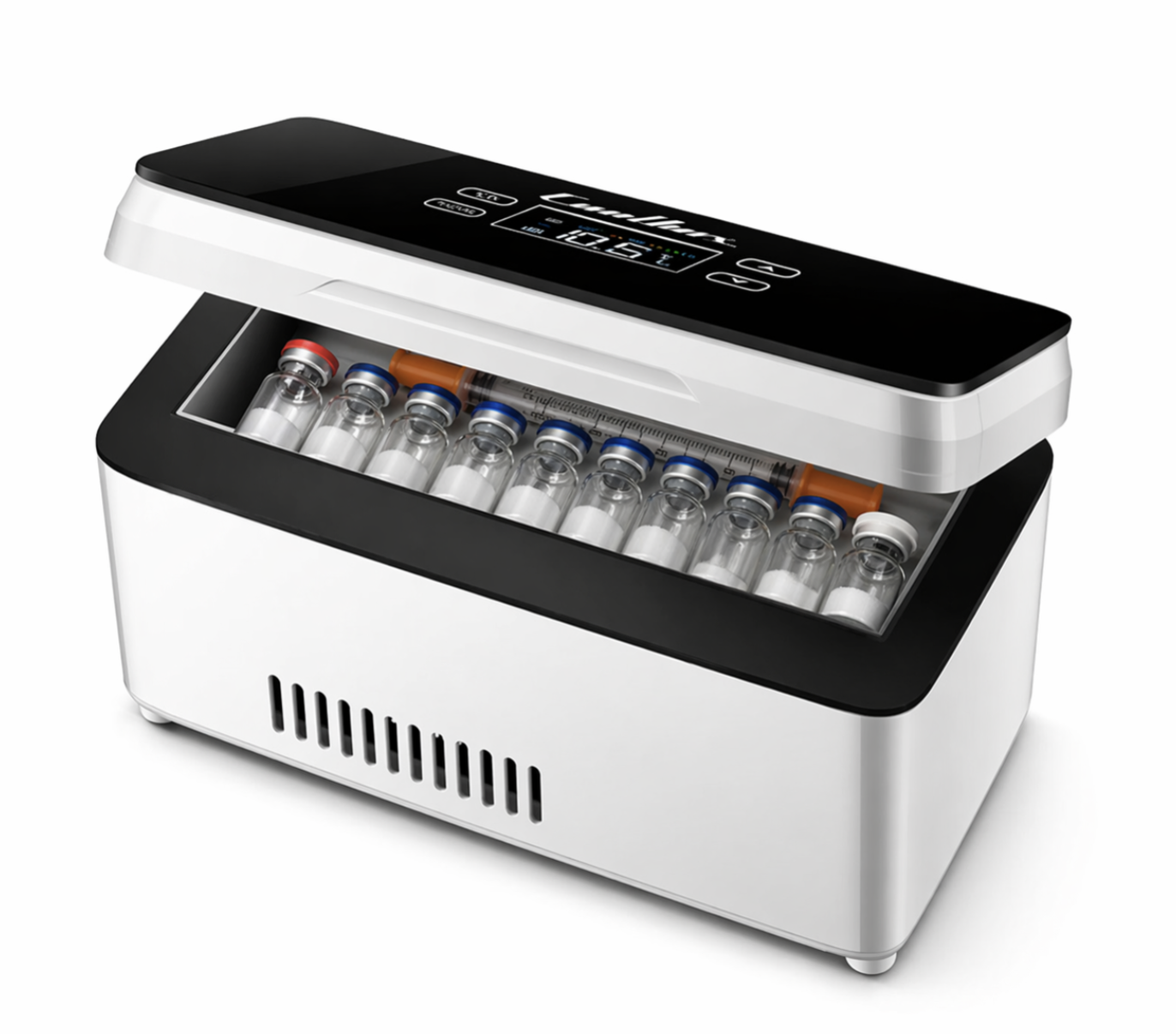
This is the central storage guide on this site. It exists because the same handful of questions arrive again and again, usually in the wrong order: people ask which refrigerator to buy long before they have read what their own products actually ask for, and they ask about temperature long before they have looked at how a vial is handled between uses. The answers exist, but they only make sense once the questions are sequenced properly.
What follows is an overview of the whole subject rather than a deep dive into any one part of it. Each major section introduces a topic, explains what genuinely matters within it, and points to a longer article where one exists. Read it end to end once and you should have a working mental model of home storage: what governs it, what you control, what you do not, and where equipment helps rather than merely reassures.
One boundary before we start, and it applies to every paragraph below. This guide contains no temperatures, no shelf lives, no degradation timelines and no claims about what happens to any compound under any condition. Those figures belong to the manufacturer of the specific product you own, and they are supplied with it. Wherever this article and that instruction appear to disagree, follow the instruction. Nothing here is medical or pharmaceutical advice, and VIALYX™ is a consumer refrigeration product rather than a medical device.
What this guide covers
- The instruction that came with your product, and why it outranks everything else.
- The difference between an item as supplied and the same item after preparation.
- What refrigeration is actually being asked to deliver in a home.
- How household refrigerators behave, and how to find out what yours does.
- What a dedicated unit changes, and what it honestly does not.
- Organisation, labelling and record-keeping that survives a busy week.
- Cleanliness and contamination prevention as a routine, not an event.
- Transport, travel and the power-cut plan you write before you need it.
- The mistakes that recur in ordinary homes, and how each one is avoided.
- Keeping the whole arrangement working across months rather than days.
Why Peptide Storage Matters
There is a practical case for careful storage that does not require any scientific claim at all. A consistent arrangement removes questions from your life. When every item lives in one known place, when each is labelled, and when the relevant dates are written down, you never have to reconstruct events after the fact. You are not standing in a kitchen at seven in the morning trying to work out whether something sat on the counter for twenty minutes or most of an afternoon, or which of two identical cartons was opened first.
That matters because the questions you cannot answer are the expensive ones. If you know exactly when something was opened and exactly where it has been kept since, you have a specific situation you can describe to the supplier who provided it, and they can tell you what it means for their product. If you do not know, nobody can help you: not the supplier, not a discussion forum, and certainly not a company that sells refrigerators. Records turn a vague worry into a question that has an answer.
The second argument is economic. Consistency is cheaper than correction. A routine costs a few minutes once and then runs on its own. Replacing something because you are no longer confident about how it was kept costs considerably more, and the decision is uncomfortable every single time. Most people who invest in storage habits do so after one of those decisions, not before.
The third argument is about attention. Storage failures rarely happen on the day you are thinking about storage. They happen on the day the school run overran, the delivery arrived early, someone defrosted the freezer, or the routine that had worked perfectly for four months met a week that did not resemble the previous four months. A system is what carries you through those weeks without requiring you to be careful, because being careful is not a plan.
It is worth being clear about what good storage is not. It is not insurance, and it is not a guarantee. Following an instruction carefully does not entitle anyone to a particular outcome, and this guide makes no promise about one. What careful storage does provide is a defensible position: you did what the documentation asked, you can describe exactly what happened, and if something unexpected occurs you are in a conversation about specifics rather than a shrug. In practice that is the entire benefit, and it is a large one.
Finally, storage is one of the few parts of this subject that is genuinely within your control. You did not formulate the product, you did not package it, and you cannot verify what happened to it before it arrived. What happens to it in your house is yours. That is a good reason to take the part you own seriously and to stop worrying quite so much about the parts you do not.
The Instruction Comes First
Before any decision about shelves, containers or appliances, read what you were told. Every product arrives with a storage instruction from the people who made it, and that instruction is the only authoritative statement about how that item should be kept. It is specific to that formulation, that packaging and that presentation. It is not transferable to the item beside it, and no general article can supply it for you.
Read the whole storage section rather than its first line. In particular, check four things: whether the instruction distinguishes between the product as supplied and the product after preparation; whether anything is said about light or about keeping the item inside its outer packaging; whether freezing is addressed one way or the other; and whether any condition carries a time limit. Those checks take under a minute, and they are the difference between following an instruction and following the part of it you happened to notice.
Then preserve it. Photograph the leaflet and the carton before the packaging goes out, and keep the images in one album on your phone. Paper leaflets vanish: the box is recycled, a drawer is tidied, and six weeks later the document you need no longer exists in your house. A photograph costs ten seconds and is the most useful piece of storage equipment most people never think to acquire.
When the instruction is unclear or missing
If the wording is ambiguous, incomplete or absent, ask the pharmacy, clinic, manufacturer or supplier who provided the product. They are the only party who can answer for their own item. A reasonable supplier will respond to a direct storage question; an unwillingness to answer one is itself informative. Do not substitute a general rule found online for a specific instruction you were unable to obtain, and be particularly wary of confident numbers offered by people who have never seen your product.
Ask better questions
When you do write to a supplier, ask narrowly. A question like "how should I store this?" invites a copy of the leaflet you already have. Questions like "does this instruction change once the vial has been prepared?", "should this stay inside the outer carton?", "is there a time limit attached to any condition, and when does it start?" and "what should I do if storage conditions were interrupted, and what information would you need from me?" produce answers you can act on. Keep the reply in writing, and file it with your photographs of the leaflet so the whole record for that product sits in one place.
Unopened Versus Reconstituted
A great deal of confusion comes from treating a product as one thing with one rule. Many products are documented in two distinct states: as supplied, and after being prepared for use. The instruction covering the first state is frequently not the instruction covering the second. The transition between them is a hard boundary in the paperwork, and it should be a hard boundary in your habits as well.
The practical response is to read the second instruction before you need it. Before anything is opened or prepared, read what the leaflet says about the state that follows and note what changes: a different location, a different handling requirement, a limit that begins at the moment of preparation. A time limit is only usable if the start date is recorded, and it has to be recorded at the moment it happens. Nobody accurately remembers a date three weeks later, and almost everybody believes they will.
Keep the two states physically separate once you hold items in both. A divided container, two labelled trays, or simply the left and right halves of one shelf all work. The point is that you should never have to work out which category something belongs to, because a glance answers it. Anything that must be worked out will eventually be worked out wrongly, on a morning when you are in a hurry.
This is also the moment where a rule of thumb picked up from someone else becomes genuinely risky. Two products that look identical, from suppliers that sound similar, can be accompanied by different documentation, and only one of those documents applies to the vial in your hand. Store per product, not per shelf, and never per anecdote.
There is a practical consequence for how you buy and stock things too. If you keep several items in different states, the state a thing is in becomes part of its identity on the shelf, and your labelling has to reflect that. A label that names the product but not its state forces you to remember, and remembering is the step that fails. Two words on a label — or two trays instead of one — remove the whole category of error, permanently, for no money.
Refrigeration: What It Is Actually For
Refrigeration in a home is not a magic state that something is either in or out of. It is a range, and it varies by location within the appliance, by how often the door opens, by how full the compartment is, and by how warm the room around it gets. A refrigerator does not deliver one uniform condition; it delivers a set of conditions that differ shelf by shelf and hour by hour. Understanding that single fact resolves most of the practical questions people have.
What you are being asked to provide, when an instruction calls for refrigerated storage, is a stable and appropriate location within that range for as much of the time as possible. Stability is doing at least as much work in that sentence as coldness. A location that stays where it should be all week is a better location than one that is colder on average but swings whenever somebody reaches for the milk.
You do not need instrumentation or expertise to act on this. You need to know what your own space does, which is a question a cheap thermometer answers in a week, and you need to keep items in the part of the appliance that is least disturbed. Whether refrigeration is required at all for a given product is not something this or any other general article can tell you — the companion guide on whether peptides need to be refrigerated explains why the answer legitimately differs between products and how to read your own documentation for it.
The thermometer is the cheapest thing you can buy
Before considering any appliance purchase, put an inexpensive thermometer on the shelf you intend to use and read it for a week, including one busy day and one quiet one. That exercise costs almost nothing and tells you more about your situation than any specification sheet. Some people discover their existing shelf is entirely reasonable and stop there. Others discover a swing they had no idea about, and now have a concrete reason to change something. Both outcomes are progress; both are unavailable to somebody who never measured.
Household Refrigerators
The refrigerator already in your kitchen is a legitimate starting point, and for plenty of households it is also the finishing point. It was designed to keep food, which means it was designed to hold a workable range while being opened repeatedly by people carrying things. That is not a disqualification. It simply means you should place items thoughtfully within it rather than wherever there happens to be a gap.
Where things go, and where they do not
The door is the worst location in the appliance. It is furthest from the cooling source, it moves every time somebody opens the fridge, and it is exposed to room air with every swing. Storage instructions and habits fall apart fastest in the door, and it is also, unhelpfully, the most convenient place to put small items. The rear wall is the opposite problem: on many appliances it runs colder than the rest of the compartment and may sit directly in front of a vent. A stable interior shelf, not touching the back, is generally the most predictable spot — but your own thermometer, not this paragraph, is the authority on your own fridge.
The realities of a shared kitchen
A household refrigerator has other occupants. Raw food, strong-smelling ingredients and anything that can leak are all sharing the space, and other people are rearranging it. Crowding also matters: a compartment packed to the ceiling restricts airflow and produces warmer pockets, while one that is nearly empty recovers more slowly after the door is opened. None of this is fatal, but all of it argues for one dedicated, uncluttered shelf with a shallow container on it rather than items scattered wherever they fit.
Privacy is the factor people mention last and feel most. A kitchen appliance is visible to housemates, family members, visitors and children, and for many people that is the real reason they start looking at alternatives — not performance. That is a perfectly valid reason, and it deserves to be stated honestly rather than dressed up as a technical argument. The detailed comparison of household appliances against dedicated ones is set out in peptide refrigerator versus regular refrigerator, which goes factor by factor rather than declaring a winner.
Small fixes that cost nothing
Before concluding that a household appliance is inadequate, try the free improvements. Move items off the door and onto a stable interior shelf. Clear that shelf of food so nobody has a reason to reach into it. Put a shallow container on it so the arrangement is a single object rather than several loose ones. Stop over-filling the compartment. Tell whoever else uses the fridge that the shelf is not available. Those five changes take one evening, cost nothing, and in a fair number of households they resolve the entire complaint that prompted the search for equipment.
Dedicated Peptide Refrigerators
A dedicated unit is a small refrigerator used for one purpose and nothing else. What it changes is mostly structural rather than thermal: the door is opened a few times a day instead of dozens, nothing inside can leak or smell, nobody else rearranges the contents, everything has one visible place, and the unit can live somewhere other than the kitchen. Those are organisation, traffic, capacity and privacy arguments, and they are the honest ones.
What a dedicated unit does not do is turn a storage instruction into something else. It does not extend anything, guarantee anything, or compensate for records you never kept. A tidy dedicated fridge full of unlabelled items with no dates written down is worse than a shared kitchen shelf run by somebody with a notebook. The equipment is the smaller half of the problem, and any seller telling you otherwise is selling rather than explaining.
What to actually compare
If you decide a dedicated unit suits you, compare the things that affect daily life: interior layout and whether vials stand upright without a custom insert; real usable capacity rather than headline litres; noise, because these units frequently live in a bedroom or office; whether there is a readable display and what it is measuring; whether a lock matters for your household; power consumption; and the seller's warranty, returns terms and willingness to answer questions in writing. The buyer's-guide treatment of that comparison lives in the guide to choosing a refrigerator for peptide storage, and the specifically compact end of the market is covered in the mini fridge buyer's guide.
Be sceptical of two things in particular while shopping. The first is a specification quoted without a source or a warranty behind it. The second is any claim about what a unit will do for the contents rather than for the space — a refrigerator manufacturer can describe its appliance, but it cannot make statements about your compound, and a page that blurs that line is a page to read carefully.
Where the unit lives
Placement deserves as much thought as the purchase. A compact unit needs clearance for airflow, a socket it can keep permanently rather than a shared extension lead somebody unplugs, a level surface, and a spot away from direct sun, a radiator or an oven. It also needs to be somewhere you will actually walk past, because a unit in a spare room at the far end of the house quietly encourages items to be left out closer to where they are used. Decide the location before the unit arrives, and check the measurement rather than estimating it.
Organisation and Labelling
Organisation is where most of the real improvement lives, and it is free. The goal is a space where every item has one obvious location, nothing has to be moved to reach anything else, and a single glance tells you what you have.
One location, one container
Choose a single interior shelf and use only that. Distributed storage — a few items here, a spare box there — is how things get lost, forgotten and left out. Put a shallow open container on that shelf so items stand upright, stay grouped and can be lifted out together when you need to clean. A container also stops small objects rolling to the back of a shelf where they become invisible for six months.
Labels that survive, records that outlive them
Label every item with what it is, using a small removable label that will not obscure the manufacturer's own printing. Then write the same information, plus any relevant dates, somewhere separate: a notebook on the shelf or a single note on your phone. Labels fall off, smudge and get soaked; a written record does not. The two together are what make a time-based instruction usable weeks later.
Keep the record simple enough that you will actually maintain it. One line per item — what it is, when it arrived, when it was opened or prepared, where it lives — is enough. Elaborate spreadsheets are abandoned within a month; a notebook with a pen tied to it survives for years. The step-by-step version of this routine, including how to review it, is laid out in how to store peptides properly.
Make the arrangement legible to someone else
A quietly valuable test: could another adult in your home look at the space and understand it without asking you? If the answer is no, the system depends on your presence, and it will fail the week you are ill or away. Legibility also matters in an emergency, when somebody else may need to know what is there and where the documentation is. A labelled container and a notebook on the shelf achieve this without requiring anyone to be briefed.
Contamination Prevention
Cleanliness in home storage is mostly about routine rather than equipment. The container and the shelf should be wiped on a schedule you actually keep — monthly is a reasonable default for most people — and the surfaces where you handle items should be clean and clear before anything is taken out. Handling on a cluttered counter beside food preparation is a habit worth breaking.
Reduce handling itself. Every extra lift, inspection and rearrangement is another opportunity for a drop, a smear or a container left out. If you find yourself opening the space repeatedly to check something, that is usually a sign the labelling is inadequate rather than that vigilance is required. Good labels remove the reason to open the door.
Keep storage away from anything that can leak, drip or shed — raw food in a shared appliance is the obvious case, but so is a defrosting freezer compartment above an open shelf. Keep items in their original outer packaging where the instruction says to, and do not decant anything into a different container for convenience. Anything to do with technique, sterility or preparation of a product itself is outside the scope of a storage guide entirely, and belongs to the clinician, pharmacy or supplier responsible for the product.
Two habits are worth adding because they cost nothing. Wash your hands before opening the space, not just before handling an item — the door handle and the container lid are touched far more often than the vials. And keep the outside of the unit as clear as the inside: a surface covered in other objects means the door gets opened while you move things, and items end up set down wherever there is room. Clear surfaces produce short, deliberate interactions, which is exactly what you want.
Transport and Travel
Travel is where good home routines most often break, because the plan is usually made at the front door with a bag half packed. Make it earlier. Start by reading the storage instruction for the specific product with the specific trip in mind: how long you will be away, what the conditions will be, and whether there is somewhere appropriate at the destination.
The practical rules are unglamorous. Keep items with you rather than in a checked bag or a car boot, because that is where you can see them and where conditions are least extreme. A parked vehicle in warm weather is the worst environment most people will ever expose anything to, and it gets there fast. Carry the documentation, and if you are crossing a border, carry whatever paperwork identifies what you have and why. Keep vials contained and upright rather than loose among clothing.
If the trip genuinely cannot meet the storage instruction, that is a conversation to have with your supplier before you leave rather than a problem to improvise around at an airport. Sometimes the answer is a different arrangement at the destination; sometimes it is not travelling with the item at all. Either way, the decision is better made a week early than an hour late.
Short journeys deserve a plan too, even though nobody makes one. A supermarket detour on the way home from collecting something, or an item carried across town in a warm bag, is the same problem in miniature. Take the direct route home, keep the item out of the sun, and put it away before you unpack anything else. Most storage compromises are not adventures abroad; they are ordinary afternoons where the item was the last thing dealt with rather than the first.
Power interruptions
Write a short plan for a power cut while nothing is happening. Decide in advance that the door stays shut, note roughly how long the outage lasted, write it down, and take that record to your supplier if it becomes relevant. What you must not do is guess afterwards, because a guess is exactly the information nobody can act on. Two lines written during a calm evening make a stressful one much simpler.
Common Storage Mistakes
These recur constantly in ordinary homes, and none of them requires carelessness — most are the natural result of an arrangement nobody ever explicitly decided.
- Applying one product's instruction to every product in the drawer.
- Using the refrigerator door, the warmest and most disturbed part of the appliance.
- Pressing containers against the rear wall, where the coldest air and any vent sit.
- Trusting a numbered dial instead of reading an actual thermometer.
- Throwing the leaflet out with the box and losing the instruction permanently.
- Leaving items on a worktop between uses because it saves a trip.
- Failing to record the date something was opened or prepared.
- Storing beside raw food, strong-smelling ingredients or anything that can leak.
- Handling vials far more often than the routine actually requires.
- Packing loose vials into a bag, or leaving them in a parked car during travel.
- Buying equipment to fix a problem that was really an organisation problem.
- Assuming a purchase ends the job, rather than starting a routine.
The pattern running through the list is that almost all of them are organisational rather than technical, and almost all of them are solved with a pen, a container and twenty minutes. The two at the end are worth dwelling on: buying equipment feels like solving the problem, and a delivery is far more satisfying than writing dates in a notebook. But a new appliance does not label anything, does not remember when something was opened, and does not stop items being left on a worktop. Fix the routine first; then decide whether the equipment adds something on top of it.
Long-Term Organisation
Systems degrade quietly. Six months in, there is usually something on the shelf nobody can identify, a label that has come off, a record that stopped being updated in the second week, and an item behind the container that has not been seen since spring. That is normal, and it is why the maintenance step matters as much as the setup.
Put a recurring reminder in your calendar every two or three months and give the space fifteen minutes. Take everything out, clean the container and the shelf, check each label against the written record, remove anything you no longer keep, and confirm the thermometer still reads what it used to. If anything is unidentifiable, deal with it then rather than pushing it to the back again — an unidentifiable item on a storage shelf is a decision you have already postponed once.
Review the arrangement itself as well as its contents, because circumstances change. More items than the container holds, a house move, a new household member, a job that involves regular travel, or simply an appliance that has started behaving differently are all reasons to revisit decisions that were correct when you made them. A setup that fitted your life last year is not automatically the right setup for this one.
Knowing when equipment is genuinely the answer
After a few review cycles you will have real evidence about your own situation rather than a hunch. If the recurring problems are lost items, forgotten dates and things left out, no purchase will help and the fix is a better routine. If the recurring problems are a full shelf, a fridge opened forty times a day, other people rearranging the contents, or a genuine lack of privacy, those are structural and a separate unit addresses them directly. That is the honest dividing line, and it is worth applying to yourself before applying anyone's product page.
Quick checklist
- Photograph every storage leaflet and carton before the packaging is discarded.
- Read the section covering the prepared state before anything is opened.
- Put a thermometer in the space you intend to use and read it for a week.
- Choose one interior shelf, not the door, and keep it clear of food.
- Use a shallow container so items stay upright and lift out together.
- Label each item and write the matching dates in a notebook or notes app.
- Keep as-supplied and prepared items physically separated.
- Decide who else can access the space and whether that is acceptable to you.
- Write a travel plan and a power-interruption plan in advance.
- Review the whole arrangement every few months and remove what you no longer keep.
Where to Go From Here
If you are still deciding whether refrigeration applies to what you own, start with the documentation and the refrigeration overview. If you know it does and you want a routine, the practical setup guide walks through it in order. If you have concluded that a separate unit fits your household, the buyer's guides cover what to compare, and the VIALYX™ peptide fridge product page documents what this particular unit is and what it currently costs. If you already know what you want, there is a walkthrough of how ordering online works and a summary of what is currently offered. None of those pages is a prerequisite for good storage, and it would be dishonest to imply otherwise.
Conclusion
Peptide storage at home is far less mysterious than it is usually made to sound. Read the instruction that came with each product and keep a copy of it where you can find it. Treat the as-supplied and prepared states as separate situations with separate rules. Learn what your own refrigerator actually does instead of what its dial claims. Give everything one location, one container and one label, with the dates written somewhere the label cannot take with it. Handle things less, clean on a schedule, plan travel before you travel, and review the whole arrangement a few times a year.
Do that and the equipment question becomes much smaller and much less loaded. A household refrigerator with a clear shelf and a thermometer is a legitimate answer for a great many people. A dedicated unit is a legitimate answer for others, usually for reasons of space, traffic, privacy or organisation rather than because a kitchen appliance failed at something. Neither is a moral position, and anyone insisting there is only one right answer has stopped describing your situation and started describing theirs.
If dedicated storage suits your setup
The product page carries the gallery, the documented features and the current specification. The guides above cover everything you would want to compare first.
Frequently Asked Questions
What is the single most important rule of peptide storage?
Follow the storage instruction supplied with your specific product. Every formulation is documented by the people who made it, and that document is the only authoritative statement about how that item should be kept. General guides — including this one — can help you build habits and organise a space, but they cannot override or replace a manufacturer's instruction, and where the two appear to disagree, the instruction wins.
Do unopened and prepared vials follow the same rules?
Not necessarily, and assuming they do is one of the most common errors. Many products are documented in two distinct states — as supplied, and after being prepared for use — and each state can carry its own conditions and its own time limits. Read the second instruction before you need it, and write down the date at the moment the transition happens rather than trying to remember it afterwards.
Is a household refrigerator good enough?
For many households it can be, provided you know what your appliance actually holds rather than what the dial suggests, you use a stable interior shelf rather than the door, and the space is clean, uncrowded and private enough for your circumstances. An inexpensive thermometer tells you more about your own refrigerator than any article can, and it is the cheapest first step available.
What does a dedicated unit actually add?
Usually predictability and organisation rather than anything dramatic. A separate space is not opened repeatedly through the day, is not rearranged by other people, holds nothing that can leak or smell, and gives every item one visible place. Those are convenience, capacity and privacy arguments. They are not claims about outcomes for any particular compound, and no honest seller should present them as such.
How should I label and record things?
Use a small removable label on the container and a matching line in a notebook or notes app. The label survives daily handling and the written record survives the label falling off. Record what the item is and any date the instruction ties a limit to, such as when it was opened or prepared. Records you can read in three months are worth more than a tidy shelf.
What should I do if something has been stored incorrectly?
Do not guess, and do not rely on how something looks. Write down precisely what happened — how long, in what conditions, and at what point in the product's life — and take that description to the pharmacy, clinic or supplier that provided it. They are the only party who can tell you what it means for their product. Accurate records are what make that conversation possible at all.
Nothing above replaces the storage instruction supplied with your own products. If any part of this guide appears to conflict with that instruction, follow the instruction.
This article is general information about home organisation and refrigeration habits. It is not medical advice, not pharmaceutical advice and not storage guidance for any specific product. VIALYX™ is a consumer refrigeration product and not a medical device. Always follow the storage instructions supplied with your own products, and direct questions about a specific compound to the pharmacy, clinic or supplier that provided it.