Storage basics
How to Store Peptides Properly: A Practical Guide
Written by the VIALYX™ team · Updated August 2026 · Roughly a 17 minute read
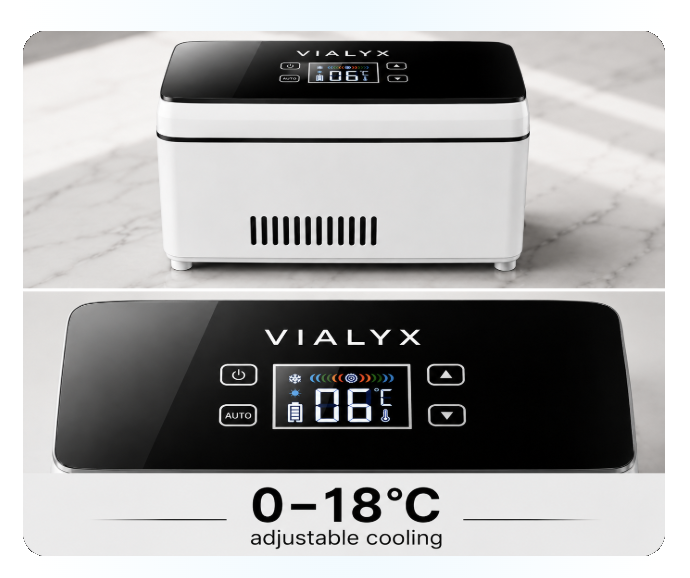
Most storage problems in ordinary homes are not caused by equipment. They are caused by arrangements that were never really decided — an item that ended up on whichever shelf had room, a leaflet that went out with the recycling, a date nobody wrote down, a routine that worked perfectly until the week it was interrupted. None of that is dramatic, and none of it requires a purchase to fix. It requires a system, and a system takes about twenty minutes to set up.
This guide is about that system. It covers how to organise a storage space, how to keep records that still make sense in three months, how to reduce unnecessary handling, how to keep things clean, what to think about when you travel, and how to decide honestly whether the refrigerator you already own is doing the job. It deliberately does not tell you what temperature anything should be held at, how long anything lasts, or what happens if conditions slip, because those answers belong to the manufacturer of the specific product you own. Wherever this article and a manufacturer's instruction appear to disagree, the manufacturer wins — every time, without exception.
Why Storage Habits Are Worth Getting Right
There is a practical argument for good storage that has nothing to do with chemistry. A consistent arrangement removes questions. When everything lives in one known place, when each item is labelled, and when dates are written down, you never have to reconstruct events after the fact. You are not standing in a kitchen trying to remember whether something spent two hours or most of an afternoon on the counter, or which of two identical-looking containers was opened first.
That matters because the questions you cannot answer are the expensive ones. If you know exactly when something was opened and exactly where it has been kept, you have a specific situation you can describe to the supplier who provided it, and they can tell you what it means for their product. If you do not know, nobody can help you — not the supplier, not a forum, and certainly not a company that sells refrigerators. Good records turn vague worry into a question with an answer.
The second argument is simply that consistency is cheaper than correction. A routine costs a few minutes once. Replacing something because you are no longer confident about how it was kept costs considerably more, and the decision is uncomfortable every time.
Start With the Instruction, Not the Equipment
The correct first step in any storage setup is to read what you were actually told. Every product arrives with a storage instruction from the people who made it, and that instruction is the only authoritative statement about how that particular item should be kept. It is specific to that formulation, that packaging and that presentation. It is not transferable to the item next to it, and it is not something a general article can supply.
Read the whole storage section rather than the first line of it. In particular, look for whether the instruction distinguishes between the product as supplied and the product after it has been prepared for use, whether anything is said about light or keeping the item in its outer packaging, whether freezing is addressed one way or the other, and whether any condition has a time limit attached to it. Those four checks take under a minute and they are the difference between following an instruction and following the part of it you happened to notice.
Then preserve it. Photograph the leaflet and the carton before the packaging is discarded, and keep the images in one album on your phone. Paper leaflets disappear; the box goes out, the drawer gets tidied, and six weeks later the instruction you need is gone. A photograph costs ten seconds and is the single most useful piece of storage equipment most people never think of.
When the instruction is unclear
If the wording is ambiguous, incomplete or missing, ask the pharmacy, clinic, manufacturer or supplier who provided the product. That is the only party who can answer for their own item. A reasonable supplier will respond to a direct question, and an unwillingness to answer a basic storage question tells you something useful in itself. Do not substitute a general rule from the internet for a specific instruction you were unable to obtain.
Two States, Two Sets of Rules
A great deal of confusion comes from treating a product as a single thing with a single rule. Many products exist in two distinct states — as supplied, and after being prepared for use — and the instruction that covers the first state frequently is not the instruction that covers the second. The transition between them is a hard boundary in the documentation, and it should be a hard boundary in your habits too.
The practical way to handle this is to read the second instruction before you need it. Before anything is opened or prepared, read what the leaflet says about the state that follows, and note anything that changes: a different location, a different handling requirement, a time limit that begins at the moment of preparation. If a time limit exists, it is only usable if the start date is recorded, and it must be recorded at the moment it happens rather than remembered later.
It is also worth keeping the two states physically separate once you have items in both. A divided container, two labelled trays, or simply the left and right halves of a shelf all work. The point is that you should never have to think about which category something is in, because a glance answers it. Anything that must be worked out will eventually be worked out wrongly on a busy morning.
If you want the fuller treatment of the refrigeration question specifically — including why two apparently similar products can carry different requirements — the companion guide on whether peptides need refrigeration goes through it in detail.
Organising the Space Itself
Once you know what your items ask for, the physical setup is straightforward. The aim is a space where every item has one obvious place, where nothing has to be moved to reach anything else, and where you can see the whole arrangement at a glance without rummaging.
Choose one location and commit to it
Pick a single interior shelf and use only that. Distributed storage — a couple of items here, one at the back there — is how things get lost, forgotten and left out. The shelf should be an interior one rather than the door, because the door is the warmest part of any refrigerator and the part most disturbed by daily use. Avoid pressing containers hard against the back wall, where the coldest air circulates and where any freezer vent sits.
Use a container, not a bare shelf
A shallow, open-topped container transforms a shelf. Items stay upright, they stay grouped, they cannot roll to the back, and the whole set can be lifted out and returned in one movement rather than handled individually. It also creates a visible boundary between your storage and the rest of the contents, which matters enormously in a shared kitchen. Clear plastic works well because you can see what is inside without opening anything.
Keep it uncrowded
A packed space is a worse space. Air needs to move around a refrigerator's interior, and a shelf crammed to the edges obstructs that. Crowding also means shifting things to reach things, which means more handling, more time with the door open, and more chances for something to be knocked over or left out. Leave visible gaps. If you cannot, the shelf is the wrong size for what you are keeping and it is worth thinking about a second space.
Separate from food
Keep your storage well away from raw food, anything that can leak, and anything strongly scented. This is basic household hygiene rather than a technical requirement, but it is also a practical one: a spill on a shared shelf means the whole shelf gets emptied and cleaned, usually in a hurry, and that is exactly the situation where items get left out on a worktop and forgotten.
Labelling and Record-Keeping That Survives
Records fail in predictable ways. Labels come off in a cold, occasionally damp environment. Ink smudges. Handwriting on a curved surface becomes unreadable. And memory — the system most people actually use — is unreliable within about a week.
The arrangement that survives is redundant: a physical label on the item and a written record somewhere else. A small removable label carrying what the item is and the relevant date handles day-to-day use; a matching line in a notebook or a notes app handles the day the label falls off or becomes illegible. Neither takes more than a few seconds, and having both means the record survives the failure of either one.
Record the things that are genuinely useful later: what the item is, when it arrived, and the date of any event that an instruction attaches a time limit to — typically when something was opened or prepared. Write dates in full and in a consistent format. Ambiguous dates are only slightly better than no dates, and in a household where more than one person might read them they can be worse.
If you keep several items, a single index — one page listing what you have, where it is, and the key dates — is worth the five minutes. It also makes the periodic clear-out trivial: you read down the list rather than emptying the shelf.
Handling Things Less
Every time an item is picked up, inspected, moved to another shelf or carried to another room, something can go wrong. It can be dropped, left out, put back in the wrong place, or simply spend longer outside its storage conditions than intended. None of these are exotic risks. They are the ordinary consequences of touching things more often than necessary.
Reducing handling is mostly a design problem. If items are visible without moving other items, you will not move them. If they are in a container you can lift out as a unit, you will not handle them one by one. If the storage location is somewhere you naturally pass rather than a room you have to make a trip to, you will return things promptly instead of setting them down "for now".
A small discipline helps too: decide what you need before you open the door, take out only that, and put it back as soon as you are finished. Open-door browsing is how a two-second retrieval becomes a two-minute one, and it is the habit most worth breaking.
Keeping Things Clean
Contamination control in a domestic setting is unglamorous and almost entirely about routine. Wash and dry your hands before handling anything. Work on a clean, uncluttered surface rather than a worktop that was used for food ten minutes earlier. Keep items in whatever outer packaging the instruction indicates, and do not leave anything open or uncovered while you do something else.
Clean the storage space itself on a schedule rather than when it becomes obviously necessary. Empty the container, wipe it, wipe the shelf, dry both, and put everything back in its place. A few minutes every month or two prevents the situation where a proper clean requires displacing everything at once. Deal with spills in a shared refrigerator immediately, and check whether anything of yours was affected rather than assuming it was not.
Follow the specific handling and preparation instructions supplied with your product exactly. This article deliberately does not describe techniques for handling or preparing any particular item, because that guidance has to come from the manufacturer, pharmacy or clinician involved with the specific product — not from a refrigeration company.
Making a Household Refrigerator Work
A normal kitchen refrigerator is a perfectly reasonable place to keep something that needs to be kept cool, and for a lot of households it needs nothing more than a little discipline. The honest caveats are about the environment around it rather than the appliance itself.
First, find out what yours actually does. A cheap thermometer left on the shelf you intend to use tells you more than any specification, because performance varies with load, ambient temperature, how often the door opens and where in the cabinet you measure. A model with a minimum and maximum memory is more useful again, because it records what happened overnight or while you were out rather than only what is happening as you look at it.
Second, be realistic about traffic. A refrigerator opened forty times a day in a busy family kitchen behaves differently from one opened four times. Third, consider who else uses it. In a shared house or a home with children or frequent visitors, a shelf that other people rearrange is a different proposition from a shelf only you touch — and that is a question about your circumstances rather than about the appliance.
If you want a longer comparison of what changes between an ordinary kitchen appliance and a purpose-built one, the write-up on how the two categories differ covers it, and there is a separate piece on choosing a refrigerator for storage use that goes through what to look for.
When Dedicated Storage Starts to Make Sense
A dedicated unit is not a requirement, and we would rather say so plainly than imply otherwise. Plenty of people manage perfectly well with a shelf in the kitchen for years. What a separate unit adds is usually not performance but predictability: a space that is not opened constantly, that nobody else reorganises, that is not competing with groceries, and where the arrangement you set up in January is still the arrangement in June.
The situations where people tend to find it genuinely worthwhile are recognisable. A shared household where the kitchen refrigerator is communal. A home where children or visitors are around and privacy or physical access control matters. A kitchen appliance that is permanently full. A living arrangement where the only available shelf is in the door. A routine that keeps slipping because the storage is somewhere you rarely go. And the simple case of keeping enough items that they need a space of their own to stay organised.
Equally, there are situations where it adds little. If your kitchen appliance is stable, if you have space on a proper shelf, if the household is small and nobody else disturbs your things, a second appliance is a convenience purchase rather than a solution to a problem. It is entirely reasonable to decide that the convenience is worth it — but it is worth knowing which of the two decisions you are making.
If you are weighing a compact unit against a general-purpose one, the comparison of compact fridges used for this purpose sets out what a generic mini fridge does and does not give you.
Where you put it matters as much as what it is
Storage you cannot see is storage you will not check. A unit in a spare room you enter twice a week will drift out of your routine, however good it is. A modest one on a landing or in a study you walk past several times a day will not. Decide the location before you decide the model, and make sure the location has a sensible power supply, enough clearance around the appliance for air to move, and a surface that is not in direct sunlight or against a heat source.
Common Mistakes Worth Avoiding
None of these are unusual. They are simply the things that happen when storage is arranged by default rather than by decision.
- Applying one product's instruction to everything in the drawer.
- Using the refrigerator door, which is the warmest and most disturbed shelf in the appliance.
- Pushing containers hard against the back wall, where the coldest air and any freezer vent are.
- Judging temperature by a numbered dial instead of a thermometer.
- Discarding the leaflet with the box and losing the instruction permanently.
- Leaving items out on a worktop between uses because it saves a trip.
- Failing to record when something was opened or prepared, which makes any time-based instruction unusable.
- Storing beside raw food, strong-smelling ingredients or anything that can leak.
- Handling vials far more often than necessary — repeated lifting, inspecting and moving.
- Packing loose vials into a bag or leaving them in a parked car during travel.
The common thread is that almost every one of them is a consequence of an arrangement that was never consciously chosen. Fixing the arrangement fixes most of the list at once.
Travelling Without Improvising
Travel is where careful routines most often break down, because it is the one situation where the usual arrangement simply does not exist. The answer is to plan it in advance rather than at the door with a bag half packed.
Begin, as always, with the instruction for your specific product, and check whether it says anything about transport or about conditions outside normal storage. If it does not, or if you are unsure whether the trip can meet it, ask your supplier before you travel rather than afterwards. That conversation is much more useful in advance.
Practically: keep items in hand luggage rather than a checked bag or the boot of a car, because a bag you can see is a bag you control. A parked vehicle is one of the most hostile environments you can leave anything in, and it is worth ruling out entirely rather than judging on the day. Use a container or insulated case so nothing is loose, keep items upright and cushioned, and carry your documentation with you — a photograph on your phone is enough and weighs nothing.
At the other end, set the arrangement up properly rather than living out of a bag. Hotel refrigerators are a mixed bag and minibar compartments in particular are often not proper refrigeration at all, so check what you actually have before relying on it. And on the day you get home, put everything back in its usual place immediately, before unpacking anything else. The items that go missing are the ones that stay in the suitcase overnight.
Staying Organised Over the Long Term
Any system degrades if it is never revisited. Items accumulate, labels fade, the arrangement that suited three things becomes cramped with eight, and the container that was tidy in spring is a jumble by autumn. A short review every few months keeps it honest.
The review is quick. Take everything out. Check each label against your written index and rewrite anything that has become difficult to read. Remove anything you no longer keep, following whatever disposal guidance applies to the product and your local rules. Wipe the container and the shelf. Confirm the thermometer still reads what you expect. Put everything back with the items you use most within easiest reach.
It is also the moment to ask whether the arrangement still fits. If the shelf is now permanently full, if you keep having to move things to reach other things, or if the location no longer suits your routine, that is useful information — and it is a much better basis for deciding whether to change anything than a decision made in the abstract.
A Setup Checklist
If you are starting from nothing, this is the order to do it in. Note that equipment comes last, after you know what your products require and what your current space actually delivers.
- Gather the storage instruction for every item you keep and photograph each one before packaging is discarded.
- Measure what your existing refrigerator actually holds, using a thermometer rather than trusting the dial.
- Choose one interior shelf as the permanent location and keep it clear of food and clutter.
- Use a shallow container so items stay upright, grouped and easy to lift out as a unit.
- Label each item and write the corresponding dates somewhere that survives the label.
- Decide who else uses that space and whether privacy or access control matters to you.
- Write down a simple travel and power-cut plan before you need either one.
- Review the whole arrangement once every few months and remove anything you no longer keep.
Conclusion
Storing things properly is mostly about removing decisions from the moment they would otherwise be made badly. Read the instruction that came with each product and keep a copy of it. Know what your refrigerator really does rather than what its dial claims. Give everything one location, one container and one label, with the dates written down somewhere the label cannot take with it. Handle things less. Clean on a schedule. Plan travel before you travel, and review the whole arrangement occasionally.
Do that, and the equipment question becomes much easier and much less loaded. A household refrigerator with a clear shelf and a thermometer is a legitimate answer for a lot of people. A dedicated unit is a legitimate answer for others, usually for reasons of space, privacy, traffic or organisation rather than because a kitchen appliance has failed at something. Neither answer is a moral position, and anyone insisting there is only one has stopped describing your situation and started describing theirs.
If dedicated storage suits your setup
The product page has the gallery, the documented features and the current specification, and there is a separate walkthrough of how ordering works.
You can also check what is currently in stock.
Frequently Asked Questions
Where should I start if I have never organised storage before?
Start with paperwork rather than equipment. Collect the storage instruction supplied with every item you own, photograph each one, and read the section that describes the product after it has been prepared as well as the section that describes it as supplied. Only once you know what each item asks for does it make sense to decide where things live or whether you need to buy anything.
Does everything I own need to be stored the same way?
No, and assuming so is one of the most common mistakes. Each product carries its own instruction from its own manufacturer, and two items sitting on the same shelf can be accompanied by different documentation. Store per product, not per shelf, and keep the instructions where you can actually reach them.
How should I label things without damaging the vial or the packaging?
Most people find a small removable label on the container plus a matching line in a notebook or notes app works well. The label survives daily handling and the written record survives the label falling off. Record what the item is and the date of anything the instruction ties a time limit to, such as when it was opened or prepared.
Is a household refrigerator good enough?
For plenty of households, yes, provided you know what it actually holds rather than what its dial says, you use a stable interior shelf rather than the door, and the space is clean, uncrowded and private enough for your circumstances. A thermometer costs very little and tells you far more about your own appliance than any article can.
What is the most useful thing a dedicated unit adds?
Usually predictability rather than performance. A separate, uncrowded space that is not opened twenty times a day, that nobody else rearranges, and where everything has a visible place tends to be easier to keep consistent than a busy kitchen shelf. That is a convenience and organisation argument, not a claim about any specific product.
How should I handle travel?
Plan it before you leave rather than at the door. Check the storage instruction for your specific product, decide how you will keep conditions reasonable in transit, keep items in hand luggage rather than a hot vehicle or a checked bag where you cannot see them, and carry the documentation with you. If the trip cannot realistically meet the instruction, that is worth discussing with your supplier in advance.
Nothing above replaces the storage instruction supplied with your own products. If any part of this guide appears to conflict with that instruction, follow the instruction.
This article is general information about home organisation and refrigeration habits. It is not medical advice, not pharmaceutical advice and not storage guidance for any specific product. VIALYX™ is a consumer refrigeration product and not a medical device. Always follow the storage instructions supplied with your own products, and direct questions about a specific compound to the pharmacy, clinic or supplier that provided it.