Storage basics
How Long Can Peptides Stay Out of the Fridge?
Written by the VIALYX™ team · Updated August 2026 · Roughly a 16 minute read
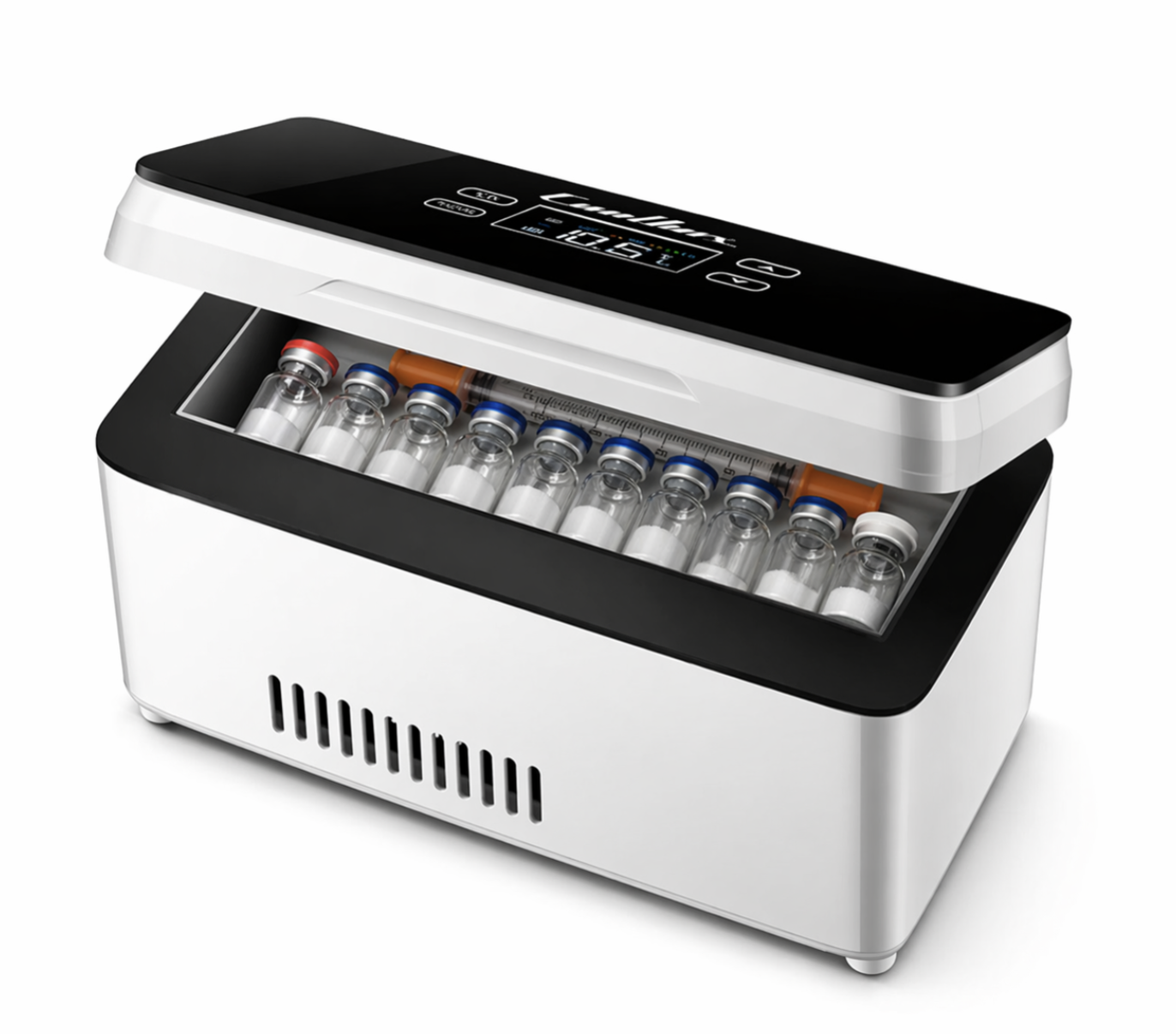
This is one of those questions that arrives with a stopwatch attached. Something is sitting on the worktop, or has been sitting in a delivery locker, or is about to spend four hours in a bag, and the person asking wants a number. An hour? A day? Longer? The appeal of a number is obvious: it converts an uncomfortable open question into something you can measure against a clock and then stop thinking about.
The difficulty is that the number does not exist in general. It exists per product, it is set by whoever formulated and supplied that product, and it is communicated through the documentation that came with it. Any article that hands you a figure without having seen your item is not being helpful; it is being confident on your behalf about something it cannot know. That is worth saying plainly at the top rather than burying it after a thousand words of preamble.
What this article can do is explain why the question resists a universal answer, what genuinely varies between one situation and the next, how unopened and prepared products differ in the way instructions treat them, which environmental factors people routinely misjudge, and how to plan so that the question stops arising in the first place. It also covers the one thing worth doing when something has already been left out and you are unsure: who to ask, and what to tell them.
One boundary applies to everything below. There are no durations, temperatures, degradation timelines, shelf lives, stability claims, study references, certifications or product specifications anywhere in this article, because those belong to individual products and are supplied with them. Nothing here is medical, pharmaceutical or laboratory advice. VIALYX™ makes a consumer refrigeration product; we are not in a position to interpret any compound’s documentation on your behalf.
The short version
There is no universal time. The answer is defined by your specific product and is stated in the documentation supplied with it, which often treats the unopened and the prepared states differently. If the documentation does not answer your question, the pharmacy, clinic or supplier who provided the product is the party who can. Everything else — planning, packaging, labelling, travel arrangements, equipment — is about making sure the question comes up as rarely as possible.
Why People Ask This Question
It is worth noticing that almost nobody asks this question in the abstract. It is asked because something has already happened, or is about to. The circumstances are remarkably consistent, and recognising your own situation in the list below is useful, because the right response differs depending on whether you are looking backwards at something that has occurred or forwards at something you can still arrange.
- A delivery arrived while nobody was home and sat in a porch, a locker or a hallway.
- Something was taken out, a phone call happened, and it stayed on the worktop far longer than intended.
- A journey took longer than planned and the arrangement made for it stopped feeling adequate.
- The documentation was read quickly and the reader is no longer certain what it said.
- A fridge door was left ajar overnight and discovered in the morning.
- Somebody wants to plan a trip properly and is trying to work out what is realistic in advance.
The backward-looking versions are harder, and they are the reason the internet is full of confident answers. When something has already been left out, the person asking wants reassurance, and there is a large supply of strangers willing to provide it. The uncomfortable truth is that reassurance from somebody who has not seen your product is worth nothing, however kindly it is offered. There is a better route, covered later on, and it takes about the same amount of time as reading a forum thread.
Why There Is No Universal Answer
The instinct behind the question is that there must be some general rule with a bit of variation around the edges — a default figure that mostly holds. That instinct is reasonable and it is wrong here, because the thing being asked about is not one thing. Products differ in formulation, in how they are supplied, in their packaging, and in the instructions their suppliers issue. Those differences are not cosmetic; they are precisely the variables that determine how a product is meant to be kept.
- The product itself, its formulation and how it was supplied.
- Whether the item is in the state it arrived in or has been opened or prepared.
- The packaging around it and whether that packaging is intact.
- The actual conditions it is sitting in, which are rarely what people assume.
- What the supplier's documentation says, which is the part that decides the matter.
- Whether anything about the situation is unclear enough to warrant a question rather than a judgement.
Look at that list and notice how much of it is invisible from the outside. You cannot infer a requirement from what a box looks like, from what a similar-looking product needed last year, or from what somebody with a comparable item does at home. Two products can sit side by side on the same shelf, appear identical to a casual glance, and carry different instructions. This is why the documentation is not a formality but the actual answer.
Why a general number would be actively harmful
It would be easy to write a figure here. It would perform well, because people search for figures and reward pages that provide them. It would also be irresponsible, for a reason worth spelling out: a number given in general does not merely fail to help, it grants permission. Somebody reads it, applies it to a product it was never about, and now has a false certainty in place of the uncertainty that would have prompted them to check the paperwork or send an email.
This is the same reasoning behind the wider question of whether refrigeration is required at all, which cannot be settled in general either. If that is closer to what you are actually trying to resolve, do peptides need to be refrigerated works through why instructions differ from one product to the next rather than pretending there is a single rule.
Unopened Versus Opened or Reconstituted Products
If there is one distinction that changes how people should read their own documentation, this is it. Instructions very frequently describe two situations rather than one: the product as supplied and unopened, and the product after it has been opened, prepared or reconstituted. These are treated separately for a reason, and they can carry different guidance.
The failure mode is predictable. Somebody reads the storage line when the delivery arrives, builds a routine around it, and never revisits the documentation. Weeks later the product is prepared, the situation has changed, and the routine has not, because the second part of the instruction was never absorbed. Nothing about this is careless in the moment; it is simply what happens when a document is read once, at the least useful time, while surrounded by packaging.
Read it as two instructions, not one
The practical habit is to treat the storage section as containing potentially two separate instructions and to identify both before anything is prepared. If your documentation only addresses one state, that absence is itself information: it is a specific question to put to the supplier rather than a gap to fill with inference. Write the question down when you notice it, because these gaps are always noticed at inconvenient moments and forgotten by the time you have a chance to ask.
- The storage section as supplied — on the carton, an insert, a label or supplier documentation.
- Whether a separate instruction applies once the product is opened or prepared.
- Whether transport, excursions or time outside storage are mentioned at all.
- Whether light, moisture, handling or packaging are referred to alongside temperature.
- Any dating information you are asked to record or observe.
- Anything the documentation does not cover — those gaps are questions for the supplier, not puzzles for you.
Environmental Factors People Consistently Misjudge
When people think about something being out of the fridge, they usually picture temperature and nothing else, and they usually picture it as a single number describing the whole room. Both assumptions are shakier than they seem. The environment an object actually experiences depends on exactly where it is sitting, what is near it, what light reaches it and what the air is doing, and these can differ dramatically within one kitchen.
Heat: the room is not one temperature
- Worktops beside ovens, hobs, kettles, toasters and dishwashers, which are warmer than the room they sit in.
- Direct sunlight through a window, which heats a small object far faster than the air around it.
- Parked cars, boots and glove compartments, which are among the most extreme environments in ordinary life.
- Radiators, underfloor heating, airing cupboards and the top of a fridge or freezer.
- Bags carried in warm weather, particularly ones left in the sun while you do something else.
- Rooms that are comfortable in the morning and considerably warmer by mid-afternoon.
Moisture: the factor nobody accounts for
- Condensation forming on cold items brought out into a warm, humid room.
- Bathrooms and kitchens during and after cooking or showering.
- Salad drawers and other humid compartments inside a refrigerator.
- Spills, drips and damp cloths on a shared shelf.
- Damp bags, wet coats and rain during transport.
- Packaging that becomes soft, stained or unreadable, which is often the first visible sign.
Moisture rarely features in people’s mental model at all, which is odd given how visible its effects are. Condensation on a cold item brought into a warm kitchen, a damp bag on a rainy day, a humid drawer inside the fridge itself, a spill from something on the shelf above: these are ordinary domestic events. The first sign is usually packaging that has gone soft, stained or unreadable, and by then the label you were relying on may have gone with it.
Light: mostly a question of packaging
- Windowsills and sunlit tables used as temporary staging areas.
- Bright outdoor light during any part of a journey.
- Items unpacked from their carton and left uncovered for convenience.
- Storage in clear containers on a brightly lit surface rather than inside a cabinet.
- Long stretches under strong artificial light in a workspace.
- Packaging discarded during unpacking, removing whatever protection it was providing.
None of these factors comes with a threshold here, and that is deliberate. They are considerations to keep in mind when choosing where something sits, not a scoring system for judging an incident after the fact. If you want the mechanics of the everyday domestic environment worked through in more depth, do peptides go bad if not refrigerated examines what heat, moisture and light actually refer to in a home.
Why the Manufacturer’s Instructions Are the Only Authority
Everything above converges on a single point. The party who formulated and supplied a product is the only party with the information needed to say how it should be kept, and the documentation they provide is how that information reaches you. Nobody writing generally — including us — has seen your item, your packaging or your paperwork, and no amount of confident prose substitutes for that.
Keep the documentation where the products are
The single habit that makes this workable is physical. Keep the carton, the insert and any supplier documentation with the items rather than in a drawer, a folder or an email archive. Photograph the label and the storage section so a smudged carton is not your only copy. When the documentation is within reach of the shelf, checking it becomes a ten-second act rather than a small project, and people check things they can check easily.
If you want the whole framework rather than this one question — what governs storage, how the pieces fit together, and where each decision sits — the peptide storage guide covers the subject end to end as a single overview.
Planning Ahead When Refrigeration Is Required
If your documentation requires refrigeration, the useful work happens before anything arrives. Nearly every anxious version of this question traces back to a moment where no arrangement existed and a decision had to be improvised: a delivery nobody was home for, a bag packed at the door, a shelf that had to be cleared while holding the item. Planning removes those moments rather than managing them.
- Decide where the item is going before it arrives, not while you are holding it.
- Arrange delivery for a time somebody is there, or to a place where it will not sit unattended.
- Have the container, the labels and the pen ready before the first delivery.
- Read the storage section once on opening and once when putting the item away.
- Keep the documentation with the container so a question never requires a search.
- Agree with the household that one shelf area is not to be reorganised.
Set up storage before the first item arrives
The other half of planning is having the destination ready. A shelf that has been cleared, a container that fits, labels and a pen within reach, and a household that knows the arrangement exists. Then the moment a delivery lands, the item goes into a defined place in one movement, rather than being put somewhere temporary while you work out what to do — a temporary location that has a strong tendency to become permanent.
Whether the kitchen fridge is a sensible destination for that container is a fair question with a practical answer that depends on your household rather than on the product; can peptides be stored in a regular refrigerator works through where a household appliance is genuinely fine and where a shared shelf becomes awkward.
What to Do If You Are Unsure
Suppose it has already happened. Something was out longer than intended, or for a length of time nobody can pin down, and you want to know what that means. Here is the honest sequence, and it does not involve this article, a search results page or a forum.
- Write down what you genuinely know rather than what you assume: times, room, packaging, sequence.
- Re-read the supplied documentation from the beginning, including the part about opened or prepared products.
- Note precisely which question the documentation does not answer.
- Contact the pharmacy, clinic or supplier that provided the product and ask that exact question.
- Do not act on a forum consensus, a friend's routine or a general article — including this one.
- Record whatever answer you receive alongside the documentation so the same question is never open twice.
The first step matters more than it looks. Write down what you actually know rather than what you have inferred: roughly when the item came out, what the room was like, whether it stayed in its packaging, whether it was in sunlight or near a heat source, and when it went back. A short factual description is far more useful to whoever you ask than a summary that has already been rounded and interpreted on the way.
Ask the party who supplied it
Then send that description to the pharmacy, clinic or supplier who provided the product. They can answer against the actual documentation for the actual item, which nobody else can do. It takes a few minutes, it produces an answer you can act on, and it closes the question rather than leaving it circling. Compare that with an hour of searching that ends in three contradictory opinions and the same uncertainty you started with.
Practical Organisation That Reduces the Question
Most of the situations that produce this question are organisational rather than technical. Something was left out because there was no defined place to put it back, or because it was one of several loose items and nobody noticed one was missing, or because the shelf had been reorganised and the routine had quietly stopped working. Organisation is how you stop generating the question.
- One labelled container so the whole set comes out and goes back as a single movement.
- A fixed home on a fixed shelf, so an empty space is immediately a question.
- Dates written at the moment they happen rather than reconstructed weeks later.
- Documentation stored with the container rather than filed somewhere sensible but distant.
- A habit of deciding what you need before the door opens.
- A quick monthly look to confirm the arrangement still matches what you set up.
The container is the highest-value change on that list by a distance. A single closed, labelled box converts a scattered collection into one object, and one object can be taken out, used and returned in a single movement. It also means that anybody reorganising the fridge moves one recognisable thing rather than distributing your belongings around the cabinet, and that a glance tells you whether everything is where it should be.
For the step-by-step version of building that setup — claiming a shelf, sizing a container, deciding what stays out and what goes away — how to store peptides properly walks through it in order rather than as a list of principles.
Travel and Time Away From Storage
Travel is where this question becomes concrete, because a journey is a defined period during which something is not in its usual place. It is also where planning pays off most obviously, since every part of a trip is knowable in advance and almost none of it is knowable at the front door with a bag half packed.
- Read what the supplied documentation says about transport before deciding anything at all.
- Plan the journey door to door, including transit, delays, taxis and the first hour after arrival.
- Keep items in original packaging with the documentation rather than decanted into unmarked containers.
- Check airline, carrier and destination rules well ahead rather than at the gate.
- Never use a parked car as a staging area, however brief the stop is meant to be.
- Ask the supplier or prescribing professional about anything the documentation leaves open.
The part people underestimate is the door-to-door span. A flight is three hours; the journey is often nine, once you include getting to the airport, waiting, transit, collecting luggage, travelling onward and the interval before you reach wherever you are staying. Plans that account only for the flight are planning for a fraction of the actual period, and the unplanned fraction is usually the warmest and least controlled part.
Cars deserve their own warning
Of all the ordinary places something might sit, a parked vehicle is the most extreme and the most casually used. A boot, a back seat in sunlight or a glove compartment during a short stop can be a long way from the conditions of the room you left. “Only twenty minutes” is how most car incidents begin, and it is worth simply ruling the car out as a staging area rather than judging each occasion individually.
When a Dedicated Refrigerator Improves Convenience
It would be easy for a company that sells a refrigerator to answer this question with “buy our refrigerator”. That would be dishonest, so here is the balanced version. A dedicated unit does not change a single word of your documentation, does not extend anything, and does not answer the question this article is about. What it changes is the practical friction around keeping a routine consistent.
- The kitchen fridge is full and the shelf keeps getting reclaimed by the weekly shop.
- The door is opened constantly and you would rather your things were not in that traffic.
- You want one place that nobody rearranges and nobody tidies without asking.
- You would prefer storage away from shared food, guests or curious children.
- You want the documentation, the container and the thermometer all in the same place.
- You value a tidy, self-contained setup enough to pay for it, which is a legitimate reason by itself.
Every item there is about space, traffic, privacy or organisation. Those are genuine problems and a dedicated unit solves them properly. It is easier to keep a routine when the shelf is not contested, the door is not opened forty times a day, and the container, the thermometer and the documentation all live in one place. Easier routines are followed more consistently, and consistency is what stops items being left out in the first place.
And when a household fridge is entirely appropriate
- You have a small number of items and a shelf you can genuinely claim.
- The household is calm and the fridge is not opened dozens of times a day.
- You are content to add a labelled container and an inexpensive fridge thermometer.
- The instruction supplied with your product is met and nothing about it is unclear.
- You would rather spend the money on something else, which is a perfectly good answer.
If most of those describe your situation, buying another appliance is spending money on a problem you do not have. A claimed shelf, a labelled container and an inexpensive thermometer will address more of this article than any purchase. If instead the structural problems are the ones you recognise, the VIALYX™ peptide fridge page documents what the unit is and what it does, with ordering online and current availability and pricing covered separately, and choosing a refrigerator for storage compares the categories without assuming a conclusion.
Summary
How long something can stay out of the fridge is not a question with a general answer, and this article has deliberately not invented one. The answer is defined per product by whoever formulated and supplied it, communicated through the documentation that arrived with the item, and often stated differently for the unopened state and the opened or prepared state. Two similar-looking products can carry different instructions, which is precisely why no article can speak for yours.
And if something has already been left out, the productive move is not more searching. Write down what actually happened, re-read the supplied documentation including the part about opened or prepared products, identify the exact question it does not answer, and put that question to the pharmacy, clinic or supplier who provided the item. A dedicated refrigerator can make a routine easier to keep and a shelf easier to defend, which is a fair reason to want one, but the household fridge is entirely appropriate in plenty of homes. Either way, the instruction supplied with your product decides how your product is kept.
If a dedicated shelf would make this simpler
The product page carries the gallery, the documented features and the current specification. The guides cover everything worth comparing before you decide anything.
Frequently Asked Questions
So how long can peptides actually stay out of the fridge?
There is no figure that applies to every product, and this article deliberately does not invent one. Time out of refrigeration is defined per product by whoever formulated and supplied it, and it is communicated through the documentation that arrives with the item. Two products on the same shelf can carry entirely different instructions. If your documentation does not address it, the pharmacy, clinic or supplier who provided the product is the party to ask.
Why does every article seem to avoid giving a number?
Because a number given in general is worse than no number at all. A figure that fits one product becomes a false permission when applied to another, and readers remember figures long after they forget the caveats attached to them. General writing is useful for habits, planning and equipment; it cannot define product-specific limits.
Does it make a difference whether the product has been opened or prepared?
It very often does. Documentation frequently describes one arrangement for a product in its supplied, unopened state and a different arrangement once it has been opened, prepared or reconstituted. People read the first line and never notice the second changes the picture. Read both, and treat them as separate instructions.
What should I do if something was left out and I do not know for how long?
Do not try to reason it out from an article or a forum thread. Write down what you actually know — roughly when it came out, the conditions of the room, whether it stayed in its packaging, when it went back — and put that description to the pharmacy, clinic or supplier who provided the item. They can answer against the real documentation.
Does room temperature mean the same thing everywhere?
No, and this is why people underestimate their own rooms. A worktop next to an oven, a sunlit windowsill, a car in the afternoon and a shaded hallway in winter are all called room temperature while being very different environments. An inexpensive thermometer where you actually store things replaces a guess with a reading.
Would a dedicated fridge remove the problem?
It removes some of the practical friction and none of the requirements. A dedicated unit gives you a shelf nobody reclaims, less door traffic and one tidy place, which makes a routine easier to keep. It does not change what your instruction says, and plenty of households manage well with a claimed shelf and a labelled container.
Nothing above replaces the storage instruction supplied with your own products. If any part of this article appears to conflict with that instruction, follow the instruction.
This article is general information about home storage habits, planning and organisation. It is not medical advice, not pharmaceutical advice and not storage guidance for any specific product. It should not be used to decide whether to use or discard anything. VIALYX™ is a consumer refrigeration product and not a medical device. Always follow the storage instructions supplied with your own products, and direct questions about a specific compound to the pharmacy, clinic or supplier that provided it.