Buying guide
Where to Buy a Peptide Refrigerator: A Buyer's Guide
Written by the VIALYX™ team · Updated August 2026 · Roughly a 10 minute read
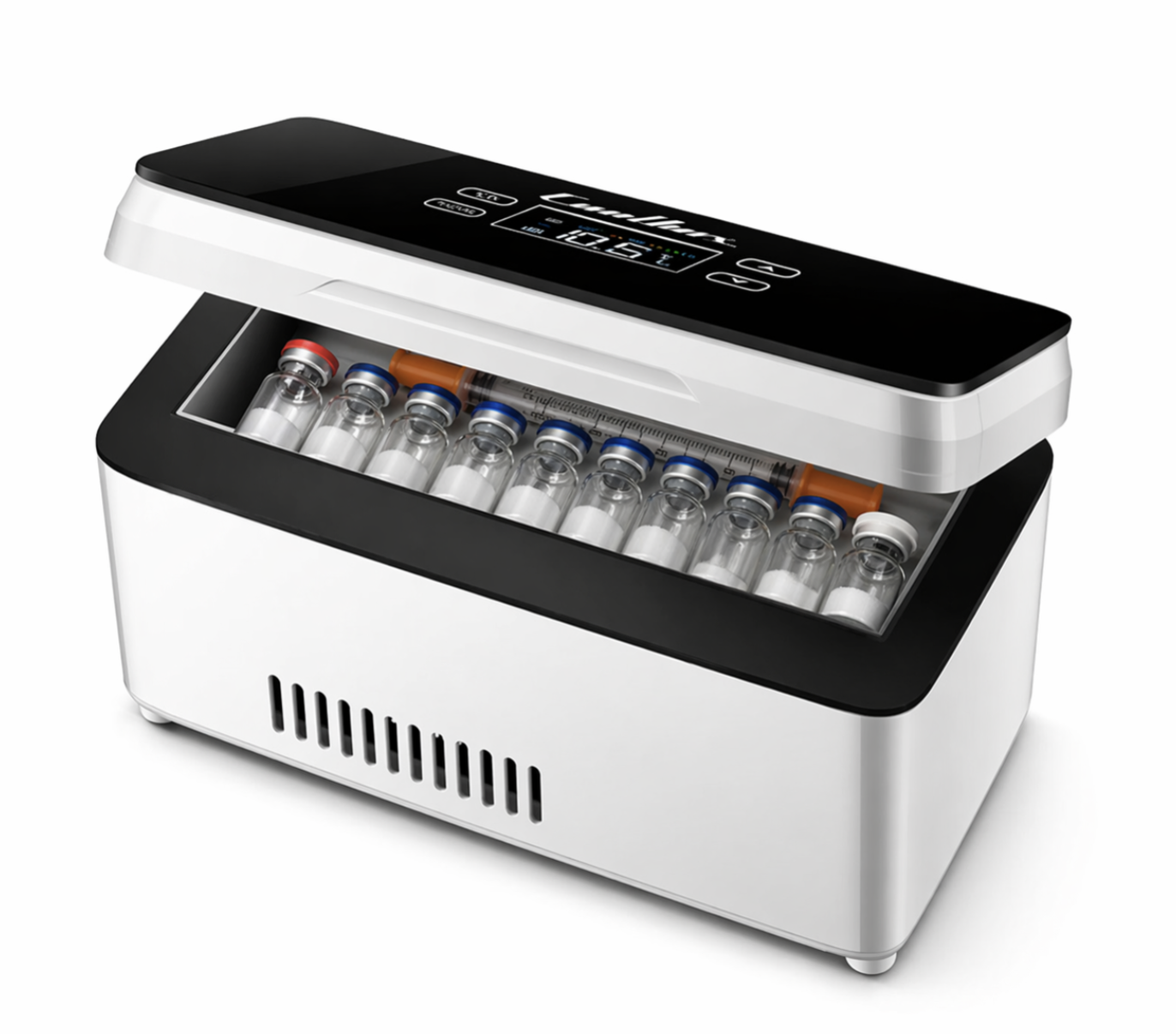
Somewhere between deciding you want a dedicated refrigerator and having one on the shelf sits a question that most buying guides skip: where do you actually get one? It is a fair question, because the category is small. Walk into a high-street appliance shop and you will find drinks coolers and under-counter units. Search online and you will find hundreds of compact fridges, a handful of which have been genuinely designed around small containers and many of which have simply had the phrase added to their title.
This guide is about the purchasing route rather than the appliance. It covers where these units are sold, how to read a product page critically, which seller and shipping details are worth confirming before you pay, and how to stop researching and place the order without regretting it a fortnight later. If what you want instead is a feature comparison, the guide to choosing between units covers that ground and this one deliberately does not repeat it.
One boundary before we start. Nothing here is medical advice or storage guidance for any specific product. Follow the instructions supplied with whatever you keep refrigerated, and treat an appliance purchase as exactly that — an appliance purchase.
1. Where Can You Buy a Peptide Refrigerator?
In practice there are five routes, and they are not equally likely to end well. You can buy direct from the company that makes or brands the unit. You can buy from an online retailer that has been appointed to carry it. You can buy from a general marketplace, where the listing sits alongside thousands of unrelated products. You can occasionally find something suitable in a local appliance or specialist shop. Or you can buy second-hand.
What separates these is not mainly price. It is how much of the transaction one identifiable party is willing to own. A dedicated compact refrigerator is a low-volume product, which means the after-sale conversation matters more than it would for a kettle: if a door seal is imperfect or a unit arrives with a dented corner, you want to know in advance who answers.
| Buying route | Where it tends to help | What to check carefully |
|---|---|---|
| Direct from the maker's own store | One party owns the product information, the order and any support afterwards; variant and plug choices are usually complete | Confirm the delivery estimate and the return window, since there is no third party to fall back on |
| An authorised online retailer | Often faster to reach, and may combine the unit with other items in one order | Check whether the retailer or the maker handles a warranty claim, and that the listing is current |
| A general marketplace listing | Wide choice, easy price comparison, familiar checkout | Identify the actual seller, the shipper and the warranty holder — they are frequently not the same |
| A local appliance or specialist shop | You can see the unit, judge the interior in person and take it away the same day | Dedicated units are rarely stocked locally; a similar-looking compact fridge is not the same product |
| Second-hand or refurbished | Lowest price, sometimes considerably | Usually no warranty, unknown door-seal condition and no support route; inspect before paying |
The table is a starting map, not a ranking. Any of these routes can be the right one depending on who is at the other end of it, which is what the rest of this guide is for.
2. Buying Direct From a Manufacturer
Buying direct means the party that designed or brands the product also takes your order. The practical benefit is continuity: the description, the variant options, the shipping arrangement and any later support conversation all sit with one company, so there is no gap between "the listing said" and "the seller only ships it". Variant coverage also tends to be complete — plug types, sizes and bundles that a third-party listing may only carry partially.
The trade-off is that you are relying on a single source for information about its own product, which places more weight on how candidly that source writes. A direct store that publishes an honest specification table, including the lines it has not yet confirmed, is telling you something useful. A direct store that answers every question with a superlative is telling you something too.
What a good direct store looks like
It names the company and gives a contact route that a human answers. It shows the interior of the product from more than one angle. It states what is in the box. It sets out delivery and returns in plain sentences with numbers in them. And it does not decorate the product with category words — medical, clinical, laboratory-grade — that it cannot substantiate.
3. Buying From an Online Retailer
An online retailer sits between you and the maker. At its best that is genuinely useful: an established retailer has a returns process it runs hundreds of times a week, a checkout you already trust, and possibly stock in your region. At its worst you gain a layer without gaining a commitment, because the retailer refers warranty issues to the manufacturer and the manufacturer refers order issues to the retailer.
The question worth asking, in one email, is who owns the warranty. If the retailer answers clearly, the extra layer is doing its job. If the answer is a shrug, factor that into the price you are comparing.
Marketplaces specifically
General marketplaces deserve their own note because they blur identity by design. The brand on the listing, the storefront collecting your money, the warehouse dispatching the box and the party honouring a claim can be four different organisations. None of that is inherently wrong, and plenty of good products are sold this way. It simply means the two minutes you spend finding the seller's real name and return terms are the highest-value two minutes of the whole purchase.
4. What to Check Before Buying Online
Reduced to essentials, there are four things to establish before your card details go anywhere: who you are paying, what you will be charged in total, what arrives and when, and what happens if it is wrong. Everything else is refinement.
Who you are paying
Find a company name and a contact route, then use the contact route once. You are not testing politeness; you are testing whether anyone is there. A seller who answers a straightforward question in a day is a seller who is likely to answer a harder one later.
What you will be charged
Compare delivered totals, never headline prices. Shipping, handling and — for cross-border orders — any duties or import charges can reorder a shortlist entirely. Where a seller cannot state a charge because it depends on your jurisdiction, the honest version of that page says so rather than implying the total is final.
What arrives and when
Confirm the exact configuration — size, plug, anything described as included — and the dispatch or delivery estimate. Estimates are estimates, and any seller who presents one as a guarantee is overpromising. A range with a carrier named is more trustworthy than a confident single number.
What happens if it is wrong
Read the return window and the damage-in-transit process before you need them. The specific thing to look for is a number of days and a named responsible party. Vague reassurance about customer happiness is not a policy.
5. How to Evaluate a Peptide Refrigerator Product Page
A product page is a document making a case. Read it the way you would read any argument: look at what it evidences, what it asserts and what it quietly leaves out.
Photographs
The exterior shot sells; the interior shot informs. You want to see the shelving, how tall the usable space is, whether small upright containers stand without leaning, and whether the door has a visible seal. A page with six flattering exterior renders and no honest interior photograph has made a choice about what it wants you to know.
The specification block
Specifications should be specific and attributable. Generic marketing lines lifted from a compact fridge template — the same phrasing you can find on twenty unrelated listings — suggest the seller has not measured anything themselves. A table that marks certain rows as to be confirmed is, perhaps counter-intuitively, a better sign than one where every row is conveniently filled.
Claim language
Watch for regulatory-adjacent vocabulary applied without support. No consumer appliance can guarantee the condition of what is placed inside it, and any listing implying otherwise is making a claim it cannot back. If a page describes itself as medical or laboratory equipment, that classification should be verifiable somewhere other than the page's own headline.
Reviews
Read them for texture rather than score. Reviews that mention specific rooms, specific inconveniences and specific fixes tell you how the unit behaves. A wall of five-word praise tells you nothing either way.
6. Specifications and Features to Verify
Independent of who is selling, there is a short list of things worth confirming in writing before you order — not because they are exotic, but because they are the ones buyers most often assume.
The external dimensions with the required clearance, so it fits the spot you measured. The interior arrangement, so your items stand upright rather than stack. Whether the temperature is shown or merely set. Whether the setpoint is adjustable in useful steps. Whether the door latches by itself. The power configuration supplied for your country. And what is physically in the box.
Where a page does not answer one of these, the correct response is to ask rather than to infer. An unstated figure is not a good figure, and it is not a bad one either — it is an unstated figure, and you are entitled to have it in a sentence before you pay. If you want the underlying reasoning about why these particular attributes matter more than litres or styling, the pre-purchase guide to dedicated units works through it in detail.
7. Shipping, Returns and Order Information
Refrigerators are heavy, awkwardly shaped and easy to damage in transit, which makes the logistics part of the purchase rather than an afterthought.
Before you order
Establish where the seller ships to, what shipping costs to your address, the dispatch window and the delivery estimate, and whether a signature is required. For cross-border orders, ask explicitly whether duties are collected at checkout or on delivery — that single question prevents most unpleasant surprises.
On arrival
Inspect the outer packaging before signing where you can, and photograph any damage before opening. Most damage claims fail on evidence rather than on entitlement. Keep the packaging until you are sure you are keeping the unit; returning a fridge in a bin bag is not a plan.
Returns and warranty
You want three numbers and one name: how many days you have to return it, who pays return postage, how long the warranty runs, and which company honours it. Anything softer than that is a sentiment rather than a term, and sentiment is not much use eight months later.
8. Questions to Ask Before You Buy
Send these as one short message. The content of the reply matters, and so does the fact that a reply arrives at all.
- 1.Which plug configuration ships to my country, and is it included rather than an accessory?
- 2.What is the total I will be charged at checkout, delivery included?
- 3.What is your current dispatch time, and who carries the parcel?
- 4.How long is the return window, and who pays for return shipping?
- 5.How long is the warranty, and which company handles a claim under it?
- 6.Which specifications on the page are confirmed, and which are provisional?
- 7.Is the item you would ship the current version shown in the photographs?
- 8.What happens if the unit arrives damaged — what is the process and the timeframe?
- 9.Do you make any medical, certification or storage-performance claims for this product?
9. Comparing Different Buying Options
Once two or three candidates survive, compare them on a single consistent basis. Put the delivered total in one column — price plus shipping plus foreseeable charges, in your own currency. Put the written commitments in the next: return days, warranty length, warranty holder, delivery estimate. Put the three daily-use attributes in the third: readable temperature, interior layout, self-latching door.
Then apply a tie-break that most buyers underweight — how the seller communicated. Speed and specificity in a pre-sale email correlate strongly with how a problem gets handled, and it is the only part of the transaction you can actually test in advance for free.
If two options are genuinely close after all that, buy the one whose page told you more, including the parts it had not confirmed. Candour about gaps is a reasonable proxy for candour generally.
10. Common Mistakes When Buying Online
Comparing headline prices
The cheapest item price is frequently not the cheapest order. Shipping, plug adapters sold separately and border charges close gaps that looked decisive on a listing page.
Assuming the photograph is the product
Colours, capacities and revisions change. Confirm that the configuration you are ordering is the one shown, particularly on marketplace listings that have been running for a long time.
Not measuring first
The most common regret is a unit that fits the space but cannot be opened in it. Measure the door swing and the clearance, not only the footprint.
Treating silence as a specification
If a page does not say it, it has not said it. Filling the gap with an optimistic assumption is how buyers end up with a dial where they expected a display.
Skipping the pre-sale email
It costs five minutes and it is the single most predictive thing you can do about the experience after checkout.
Rushing a discount
Urgency is a sales technique as often as it is a fact. A unit worth buying at a discount is worth buying next week; a unit that only makes sense inside a countdown probably does not make sense.
11. Where VIALYX™ Fits Into the Buying Decision
VIALYX™ is sold direct, which means the same organisation writes the product information, takes the order and answers afterwards. We think that is the honest arrangement for a low-volume product, and it also means we cannot pass a difficult question to somebody else.
On specifications we follow the rule this article recommends you demand: what is confirmed is published, and what is not yet confirmed is left visibly open on the product page rather than filled in with a number that would look plausible. That is deliberately less tidy than a complete table. It is also the difference between a specification and a guess, and you deserve to see which is which.
On classification, plainly: VIALYX™ is a consumer refrigeration product intended for dedicated home storage. It is not a medical refrigerator, a medical device or laboratory equipment, and we make no certification, regulatory or stability claims for it. If your situation requires equipment in one of those categories, buy from that category instead — we would rather say so than take an order that does not suit you.
See the product for yourself
The product page holds the gallery, the interior photographs, the feature list and the specification table exactly as it stands today — including the rows still marked to be confirmed.
12. How to Buy a VIALYX™ Peptide Fridge
The route is short. Read the product page and check the specification table, including what is still open. Choose the size that matches the space you measured and the number of items you keep. Select the plug configuration for your country. Then complete the order through online ordering, where the current price, options and shipping arrangements are set out in one place.
Two clarifications worth stating. We do not assert availability in this article, because stock and dispatch information changes and a blog page is the wrong place to promise it — the current offer page is where that lives. And if anything you need is not written down before checkout, ask us first; a pre-sale question is far cheaper for both of us than a return.
13. Buyer Checklist
Run this against any listing, including ours. If more than two lines cannot be answered from the page or from the seller, keep looking.
- I know the legal name of the party I am paying, not just a storefront label.
- There is a contact route on the page and I have used it once before ordering.
- The plug or power configuration listed matches my country, with no adapter assumed.
- I have the delivered total: item price plus shipping, handling and any charges the seller can foresee.
- The delivery estimate is written on the page or was confirmed to me in writing.
- The return period is stated in days, along with who pays return postage.
- The warranty length is stated, and I know which party honours it.
- Interior photographs show the shelving and layout, not only a styled exterior.
- The specification table separates confirmed figures from anything still to be confirmed.
- Any figure I am relying on appears in text, not only in marketing imagery.
- I measured the intended spot, including door swing and the clearance the maker asks for.
- The listing avoids medical, clinical or laboratory claims — or, if it makes them, I can verify them independently.
- I compared at least one alternative on the same delivered-total basis.
- Nothing important is left resting on an assumption I made rather than a sentence the seller wrote.
14. Frequently Asked Questions
Is it better to buy direct from the maker or from a retailer?
Neither is automatically better; they fail in different ways. Direct usually means one party owns the product information, the order and any support conversation afterwards, so there is nobody to pass you along to. A retailer can be quicker to reach, may consolidate a larger order, and sometimes carries stock closer to you. The deciding question is the same either way: which of the two has written down the answers you need — plug type, delivered price, return window, warranty holder — before you pay?
What should I confirm before placing an online order?
Four things, in writing rather than implied by photographs. The plug or power configuration supplied for your country. The delivered total including shipping, handling and any import charges the seller can foresee. Who handles a return or a warranty claim and within what window. And which specifications are confirmed versus which are still marked as to be confirmed. If a page leaves one of those blank, ask before ordering rather than assuming the omission is favourable.
How can I tell a serious product page from a relabelled listing?
A serious page shows the interior properly, not just a styled exterior, and it separates what it knows from what it does not. Relabelled listings tend to do the opposite: heavy adjectives, one flattering angle, a specification block copied from a generic compact fridge, and category words like clinical or laboratory-grade used loosely. Read the interior photographs and the specification table; ignore the headline vocabulary.
Should I buy from a marketplace listing?
You can, but check who is actually selling. On many marketplaces the storefront name, the party who ships the unit and the party who honours a warranty are three different entities, and that only becomes relevant when something goes wrong. Before paying, find the seller's name, a contact route that answers, and a written statement of the return period. If those are not visible on the listing, treat the price advantage as smaller than it looks.
What does VIALYX™ publish about the fridge?
Only what is confirmed. Where a figure has not been verified, the product page leaves it visibly open rather than filling it with a plausible-looking number, so you can see the difference between a specification and an estimate. VIALYX™ is a consumer refrigeration product for dedicated home storage — not a medical refrigerator, medical device or laboratory equipment — and we publish no certification, regulatory or stability claims.
How do I move from researching to actually ordering?
Set a stopping rule. Decide the location and measure it, decide how many items you keep, pick the size that satisfies both, then shortlist no more than three options and compare them on delivered total and written commitments only. Anything still unanswered at that point becomes one email to the seller. If the reply is clear, order; if it is vague or slow, that is information too, and it costs nothing to walk away before paying.
15. Conclusion
Where to buy turns out to be mostly a question about who, not about which website. The routes available — direct, retailer, marketplace, local, second-hand — each work when there is an identifiable party willing to write down the total, the timing and the terms, and each disappoint when there is not. That is the test, and it is quick to apply.
So: measure the space, count your items, shortlist three, send one email, compare delivered totals against written commitments, and then order. Research beyond that point rarely improves the decision. If you would rather see how the compact end of the market compares before you commit, the compact fridge comparison is the natural next read.
Ready to place an order?
See the current options, plug choices and shipping details in one place. VIALYX™ is sold as a dedicated consumer product, with no medical or certification claims attached.
This guide is general purchasing information about refrigeration equipment. It is not medical advice, not regulatory guidance and not storage guidance for any specific product. Always follow the instructions supplied with your own products.