Buying guide
Peptide Fridge for Sale: What to Compare Before You Buy
Written by the VIALYX™ team · Updated August 2026 · Roughly a 9 minute read
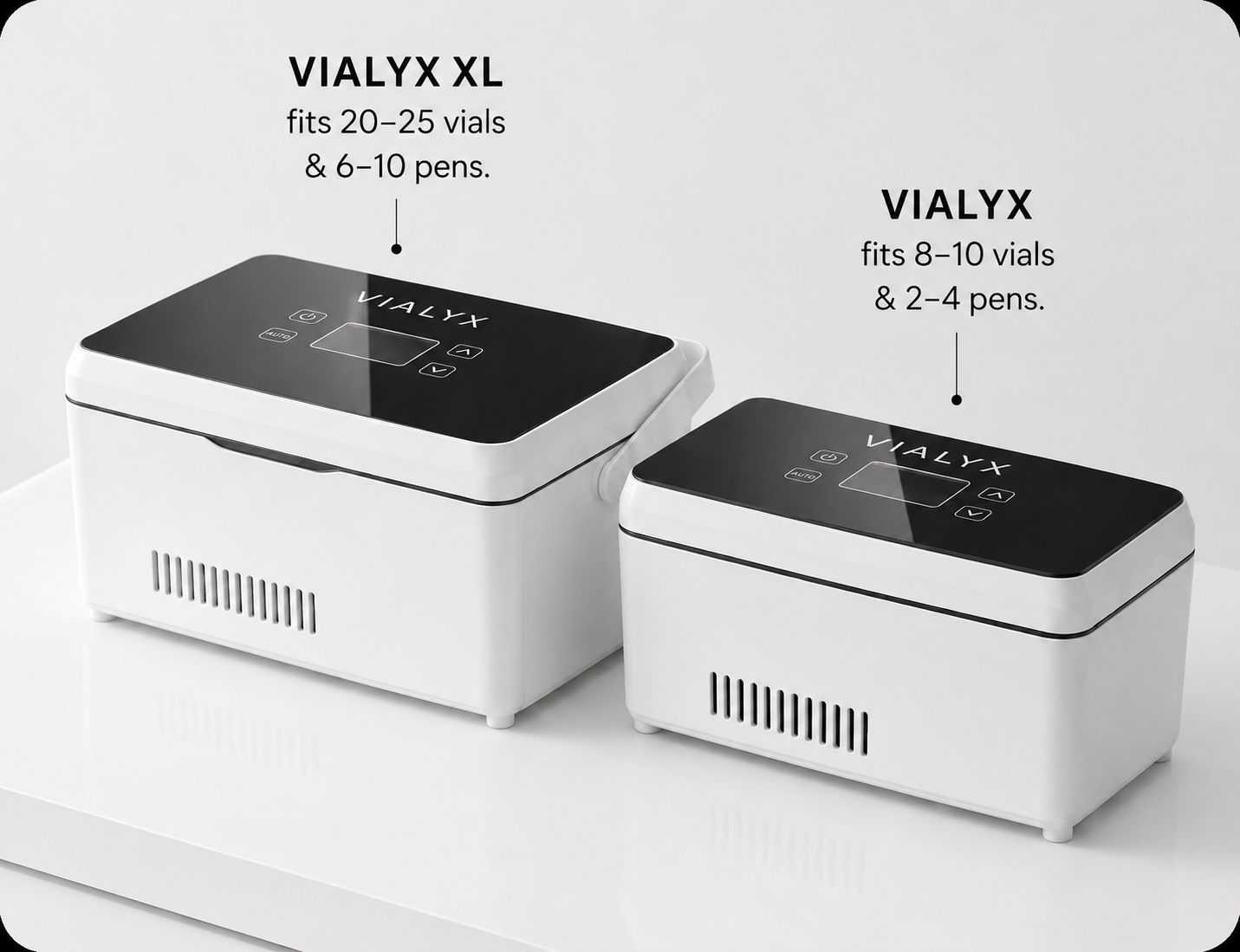
Most people who search for a peptide fridge are not asking a theoretical question about refrigeration. They have a shelf, a bedside table or a corner of a desk in mind, a handful of items that currently live in a busy kitchen fridge, and a wish to stop guessing. This guide is written for exactly that moment: a compact, dedicated unit is on the table and you want to know what actually distinguishes a good one.
The distinction we keep coming back to is not size. Compact is a constraint you have chosen, not a virtue in itself, and a smaller cabinet that forces you to stack is worse than a slightly larger one that does not. What makes a compact fridge good is how well its interior is arranged for what you keep, whether you can see what it is doing, and whether it sits somewhere you will genuinely use it.
To be clear about roles: this article is comparison and education. If you already know what you want and simply need the current offer, ordering details and what is included, the product offer page is the place for that. And nothing here is medical advice — follow the guidance supplied with whatever you store, then choose equipment that lets you meet it.
1. What Is a Peptide Fridge?
"Peptide fridge" is a shorthand buyers coined rather than an appliance category with a formal definition. In practice it describes a compact refrigerator bought for one job: holding a small number of refrigerated vials, pens or cartridges in a single dedicated place, separate from food, with the interior conditions visible rather than assumed.
That definition matters because the phrase gets attached to products that meet none of it. A generic compact fridge relabelled for the search term is still a can cooler. Judge any listing against the three ideas in the sentence above — dedicated, arranged for small containers, observable — rather than against the words in its title.
What it is not
It is not laboratory or institutional equipment, and it should not be described as such. Terms like medical, clinical, pharmaceutical or laboratory-grade are regulatory-adjacent and are used loosely in consumer listings. No consumer appliance guarantees the stability of what you put inside it, and any listing implying otherwise is making a claim it cannot support.
2. What to Look for When Shopping for a Peptide Fridge
When you are actively comparing products rather than deciding whether to buy at all, the useful questions get quite narrow. Will my items stand upright and stay visible in this interior? Can I read the temperature without opening the door? Does this footprint fit the exact spot I measured? And is the seller specific in writing about delivery, returns and warranty?
Those four filters will thin a shortlist quickly. Notice that none of them is a styling question and none is about litres. Litres tell you about volume; they tell you nothing about geometry, and geometry is what decides whether a compact unit works.
If you are earlier in the process and still weighing whether a dedicated unit is worth buying at all, the wider pre-purchase guide to buying a dedicated unit covers seller vetting and verification in more depth than we will repeat here.
3. Size and Footprint
Start with the space, not the product. Measure width, depth and height at the intended location, then add the clearance the manufacturer asks for and check the door can open fully without hitting a wall, a cupboard edge or a chair. A unit that technically fits but cannot be opened comfortably will be moved within a month.
Then be honest about direction. A smaller cabinet is easier to place and easier to live with, but it only stays pleasant while your items fit in one layer. If you routinely keep more than a small handful, a slightly larger interior is the better purchase even though it costs you a little more surface. Where two sizes of the same product exist, the deciding factor should be your item count and your measured space — not an instinct that smaller is neater.
The two regrets
In our experience buyer regret runs in exactly two directions. Too small, and you stack immediately, lose visibility and handle items more than necessary. Too large, and you find nowhere sensible for it, so it ends up in a hallway or a garage where it is inconvenient and working harder than it should. Measuring and counting before you order prevents both.
4. Storage and Organization
The interior is where a dedicated fridge earns its price. What you want is simple: every item standing upright, held so it cannot tip or roll, visible at a glance, and reachable without moving anything else. If a design delivers that, organisation looks after itself. If it does not, no amount of discipline will keep it tidy.
Look for interior photographs showing the cabinet loaded with items of the type you keep, and count them. If a listing only ever shows the inside empty, or shows it holding cans, that omission tells you who the product was designed for. Also consider whether items are grouped in a way that suits how you use them, since a layout you have to reorganise every time defeats the point.
Access is part of organisation. A shallow arrangement where nothing sits behind anything else is almost always better in daily use than a deeper cabinet with two rows, even when the deeper one holds more on paper.
5. Temperature Monitoring
This is the feature we would not compromise on in a compact unit, because compact cabinets react faster to a door being left open or a warm room. A dial marked one to seven shows where a knob is pointing. A displayed reading tells you what the inside is actually doing, and turns a daily assumption into a two-second check.
When comparing listings, separate three things that get blurred together: whether the number shown is the interior reading or the setpoint, whether it is visible from outside so you do not have to open the door to check, and whether the setpoint is adjustable in meaningful increments rather than vague modes. All three change how much you can trust the unit.
If a unit shows nothing
Budget for an independent thermometer in the same order and treat it as part of the price. This is the same recommendation we make for kitchen shelves and general compact units in the compact fridge comparison, and it applies with equal force to anything sold as dedicated but shipped without a readout.
6. Placement and Everyday Convenience
Convenience is not a soft factor; it decides whether the fridge is used properly a year from now. Anything you have to move to open, unplug to clean, or reach across something to use will gradually be worked around. So choose the location first and let it drive the specification.
A bedroom raises the importance of noise, and of a hard level surface, since almost any refrigeration sounds worse on a soft or uneven base. A study or living room raises the importance of appearance and cable routing. A shared kitchen raises the importance of separation, and sometimes of a lock. An unheated garage or utility introduces year-round ambient swings the unit must fight, which is usually a reason to choose somewhere else. Our room-by-room guide for home placement works through these trade-offs in more detail if the location is still undecided.
One practical point for compact units specifically: because they are light enough to move, people move them. Decide on a permanent home and keep it there, so the unit is never running in a spot it was not chosen for.
7. Dedicated Peptide Fridge vs Generic Mini Fridge
This is the comparison most shoppers are actually making, and it deserves a straight answer rather than a pitch. The table sets out where the two genuinely differ. Individual models vary, so read it as the shape of each option rather than a specification of any product.
| Factor | Dedicated peptide fridge | Generic mini fridge |
|---|---|---|
| Interior shape | Built around small upright containers that stay visible | Can racks and tall shelves; small items roll and hide |
| Reading the temperature | Normally shown, so a check takes two seconds | Usually a numbered dial with nothing to read |
| What else goes inside | Nothing — one category of item, one place | Drinks, snacks, leftovers, whatever fits |
| Footprint per useful slot | Small exterior, interior arranged for the items you keep | Larger exterior, much of the volume unusable for small items |
| Everyday handling | Reach one item without moving the others | Shuffle the front row to reach the back |
| Typical price | Higher; the premium buys layout and visibility | Lower, sometimes considerably |
| Seller commitments | Named warranty, return window, support route | Varies; marketplace listings often commit to little |
| Best suited to | Anyone who wants storage separate, organised and visible | Anyone who mainly needs extra cold space |
The fair conclusion: if all you need is more cold space and you are content to add a thermometer, a generic compact fridge is the cheaper and perfectly reasonable answer. If you want your items separated, upright, visible and checkable, a dedicated unit is what you are shopping for and the price difference buys those specific things.
8. What Features Are Worth Comparing?
Rank features rather than collecting them. In the top tier sit the three that shape daily use: a readable interior temperature, an interior arranged for upright small containers, and a door that seals and latches on its own. A unit missing any of these is compromised no matter what else it offers.
The second tier is genuinely valuable but personal. Quieter running matters in a bedroom and not in a utility room. A lock matters in a shared household and not if you live alone. Portability matters if you travel and is dead weight in the price if you do not. A larger size matters if your item count is growing. Judge each against your own week.
The third tier is presentation — finish, interior lighting, colour choices. Pleasant, and worth nothing if the first tier is absent. For a longer treatment of how to weight features against one another across the whole category, see our guide to choosing the right peptide fridge.
9. What to Check on a Product Listing
Read the page for specifics rather than tone. You want loaded interior photographs, a specification table rather than adjectives, a clear statement of what is in the box, the plug type for your country, a delivered price, a delivery estimate, a return window in days, a warranty length, and the name of the business selling it.
Then notice absences, because they are informative. A listing built entirely from styled exterior renders has not shown you the part that matters. A listing describing performance only in superlatives has told you nothing measurable. And a page publishing a suspiciously precise figure with no documentation behind it is less trustworthy than one that leaves the line blank. An honest gap beats a confident guess.
10. Questions to Ask Before Buying
Send a short list before you pay. How fast and how specifically a seller replies is itself part of what you are buying.
- How many items of my type fit upright, in one layer, without stacking?
- Is the number on the display the interior reading or the setting?
- What are the external dimensions, and how much clearance should I leave around it?
- Which plug ships to my country, and is anything else required?
- What does it cost delivered to my address, including any handling?
- How long is delivery, and what is the process if it arrives damaged?
- What is the return window, and who pays return shipping?
- How long is the warranty and what does it cover?
- Which specifications on the page are still to be confirmed?
On our side, the answers to the commercial half of that list live on the online ordering page, so you can weigh a delivered total instead of a headline number.
11. Common Mistakes When Shopping for a Peptide Fridge
Choosing the smallest option because compact sounds tidy. Compact is only tidy while everything fits in one layer; past that point it is the opposite. Count first.
Choosing on litres instead of geometry. Volume figures include space a small upright container can never use, which is why two units with identical capacity can hold very different numbers of items.
Buying a unit with no readable temperature and planning to add a thermometer later. Later rarely arrives; order it at the same time or buy something that shows you a number.
Not measuring the location, which remains the most common cause of a return. Choosing a spot that is inconvenient, so the fridge is worked around rather than used. Comparing headline prices instead of delivered totals. And ordering from a listing with no named business behind it, which is cheap right up until something needs fixing.
12. VIALYX™ Peptide Fridge
VIALYX™ exists because of the gap this article keeps describing. A kitchen fridge is shared, busy and silent about its conditions; a generic compact fridge is arranged for drinks. VIALYX™ is a consumer refrigeration product made for one purpose — giving refrigerated vials, pens and cartridges a single dedicated place at home, arranged for small upright containers, with a temperature you can see rather than assume.
We are deliberately conservative about what we publish. Confirmed details appear on the VIALYX™ Peptide Fridge page as they are verified in writing, and anything unconfirmed is left visibly open instead of filled with a plausible figure. Said plainly: VIALYX™ is not a medical refrigerator, not a medical device and not laboratory equipment; we make no regulatory, certification or stability claims. If your situation requires certified, documented equipment, that is a different category and we would tell you so.
Where two sizes are offered, treat the choice the way this guide suggests — count your items, measure your spot, and pick accordingly rather than defaulting to the smaller one.
Want to see the fridge itself?
The product page holds the gallery, the interior shots, the feature list and the specification table exactly as it stands today — including the lines still to be confirmed.
13. How to Choose the Right Option
Work in this order. Decide the location and measure it. Count the items you keep. Choose the size that fits both of those honestly. Then filter candidates on the three top-tier features. Only after that compare delivered prices and seller commitments, because a cheaper unit that fails the first four steps is not cheaper at all.
There is also a legitimate answer of "not yet". If you keep one or two items, live alone, and have a calm corner of a kitchen shelf, a thermometer and a little discipline may be all you actually need. We would rather say that than sell you a second appliance you will not use.
If you do want the dedicated route, the remaining question is which unit and from whom — and that is what the checklist below is for. When you want the commercial detail rather than more comparison, the current buying options set out price, plug choices and shipping in one place.
14. Peptide Fridge Buying Checklist
Run this against any listing, ours included. If more than two lines cannot be answered from the page or from the seller, keep shopping.
- I have measured the exact spot, including door swing and the clearance the maker asks for.
- The surface is hard and level, and nothing has to be moved to open the door.
- There is a socket within reach without a lead crossing a walkway.
- The plug supplied matches my country, with no adapter assumed.
- I counted the items I keep today and allowed modest headroom, not triple.
- Interior photographs show items like mine standing upright, unstacked.
- I can reach any single item without rearranging the others.
- The unit shows an interior temperature rather than only a setting.
- The setpoint is adjustable in meaningful steps.
- The door seals and latches by itself rather than depending on how I close it.
- Noise is acceptable for the specific room I have chosen.
- The price I compared is the delivered total, including shipping and handling.
- Return window, warranty length and delivery estimate are all written down.
- The seller answered a question before I paid.
- Anything I am relying on is documented, not implied by the styling of the photos.
15. Frequently Asked Questions
Is a compact fridge always the better choice?
No, and it is worth saying plainly. Compact suits people who keep a handful of items and want the unit somewhere specific — a bedside table, a shelf, a desk return. If your routine involves a larger number of items, a bigger interior stops you stacking, and stacking is what actually ruins organisation. Choose the size that matches your item count and your measured space, not the smallest one available.
What separates a dedicated peptide fridge from a mini fridge?
Three things, mostly. The interior is arranged so small containers stand upright and stay visible instead of rolling behind a can rack; the temperature is usually something you can read rather than a dial you have to trust; and the unit holds one category of item, so nothing gets pushed aside for leftovers. A mini fridge is cheaper and will get cold — it just was not designed for any of the above.
Where should I put a peptide fridge?
Somewhere it will be used without effort, on a hard and level surface, with a socket in reach and the clearance the maker asks for. A bedroom or a study usually beats a garage, because unheated spaces swing in temperature all year and a fridge has to work against that. If the spot means moving something every time you open the door, pick a different spot.
How many items should I plan for?
Count what you keep refrigerated in a typical month, then add a little headroom rather than a lot. Buying for a hypothetical future several times your current volume normally means paying for empty space and losing floor area. Buying for exactly today means stacking within weeks. The middle is the right answer for most people.
How do I compare two listings fairly?
Compare delivered totals with shipping and the correct plug included, then compare what each seller commits to in writing — return window in days, warranty length, delivery estimate, and a contact route that answers before you pay. After that compare the three things that affect daily use: readable temperature, interior layout, and whether the door seals and latches by itself.
What does VIALYX™ publish about the fridge?
Only what is confirmed in writing. Anything not yet verified is left visibly open on the product page rather than filled with a plausible number, so you can see the difference between a specification and a guess. VIALYX™ is a consumer refrigeration product for dedicated home storage — not a medical refrigerator, medical device or laboratory equipment — and we publish no certification, regulatory or stability claims.
16. Conclusion
A compact dedicated fridge is a good purchase when it is chosen in the right order: space first, item count second, features third, price last. Insist on an interior that holds your items upright and visible. Insist on a temperature you can read. Put the unit somewhere you will actually use it, and resist the idea that the smallest option is automatically the neatest.
Do that and you will buy once and be content, whichever product you choose. And whatever you keep inside, follow the guidance supplied with it rather than any appliance listing — ours included.
Ready to compare what is available?
See the current offer, size and plug options, what is included and how shipping works. VIALYX™ is sold as a dedicated consumer product, with no medical or certification claims attached.
This guide is general purchasing information about refrigeration equipment. It is not medical advice, not regulatory guidance and not storage guidance for any specific product. Always follow the instructions supplied with your own products.