Buying guide
Best Peptide Fridge for Home Use: What to Look For Before You Buy
Written by the VIALYX™ team · Updated August 2026 · Roughly an 8 minute read
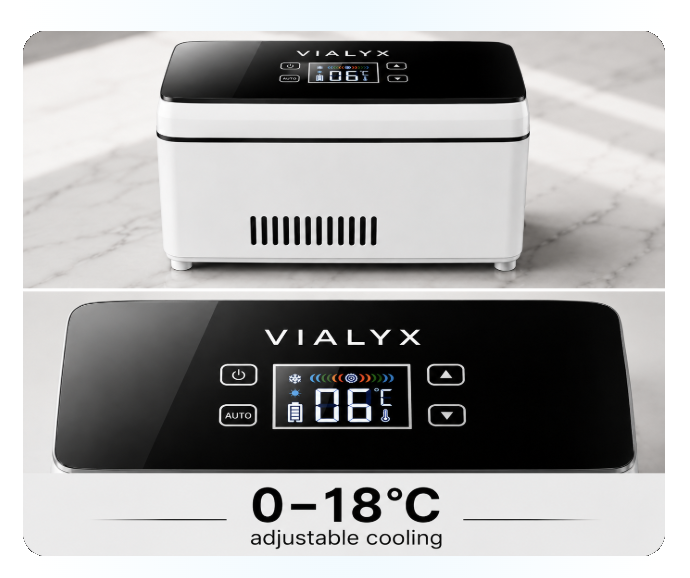
Buying a refrigerator for a laboratory is a specification exercise. Buying one for your home is a domestic one. The unit has to fit a real corner of a real room, live beside people who did not ask for it, run quietly enough that nobody resents it, and still make your storage easy to reach on a weekday morning when you are already late.
That is why the "best" home option is rarely the biggest or the most technical. It is the one that suits the space you actually have. This guide walks through the practical home decisions in the order you will face them: where it goes, how big it should be, how you will check the temperature, how the inside is arranged, what noise and power mean at home, and what to confirm before you place the order.
One boundary first. We do not publish storage instructions, and no refrigerator can promise how a specific compound behaves. Storage requirements come from the instructions supplied with your own products. Everything below is about choosing and living with hardware.
1. What Makes a Good Peptide Fridge for Home Use?
A good home unit does three domestic things well before it does anything clever. It disappears into the room — physically, acoustically and visually. It makes the right handling easy, so you open the door once, take what you need and close it. And it tells you what it is doing without asking you to open it.
Notice how little of that is about cooling. Nearly any working refrigerator gets cold. Far fewer are sized for the spot beside your desk, quiet enough for a bedroom, arranged for small containers rather than yoghurt pots, and honest about their interior temperature. Those are the differences you feel every single day at home, and they are the ones product pages tend to skip.
The home test
Before comparing models, picture the whole routine: walking to the unit, opening it, finding the item on the first look, closing the door, and glancing at a reading as you leave. If any step in that sequence is awkward, you will start improvising — leaving the door open longer, moving items to the kitchen "just for now", stacking things on their side. Choose the unit that makes the tidy version of the routine the effortless one.
2. Choosing the Right Size for Your Space
Home buyers get size wrong in both directions. Some buy a large cabinet for a small hallway and lose a walkway; others buy the smallest thing available and discover their containers will not stand upright inside. Both mistakes are avoidable with a tape measure and five minutes.
Measure the location, not the fridge
Pick the exact spot first. Measure width, depth and height there, then measure the arc the door needs to swing open without hitting a wall, a chair or a cupboard handle. Add whatever clearance the maker asks for around the vents — a compact unit squeezed into a tight alcove works harder and holds its setting less comfortably than the same unit with air around it.
Then measure your contents
Count what you keep on hand today and add modest headroom for a reorder overlap. More useful still, measure your tallest container and compare it against the internal shelf height rather than trusting a litre figure. Capacity in litres tells you about volume; it tells you nothing about whether a pen stands up with the shelf in place. If you are weighing up compact models specifically, our guide to compact refrigerators goes deeper on that trade-off.
3. Temperature Monitoring and Consistency
At home, monitoring is not a laboratory nicety — it is what turns storage from an assumption into something you can check. A unit with a bare numbered dial states an intention. A unit that reports a reading states a result, and it does so without you opening the door and disturbing the interior to find out.
Consistency matters just as much as the number. The things that unsettle a home fridge are domestic: a door left slightly open, a hot room in July, a unit pushed too close to a wall, or sunlight falling on the cabinet in the afternoon. None of those are exotic faults. All of them are visible if you can read the interior at a glance, and invisible if you cannot.
If a model has no display
Buy an inexpensive fridge thermometer and keep it inside on the shelf where your items sit. It is a small cost that converts guesswork into a number, and it is worth doing even on a unit that does have a display, as a second opinion. Ask one question of any shortlisted model: if this drifted tonight, would I know tomorrow morning?
4. Organization and Easy Access
A home fridge is opened by a person in a hurry. The interior should be arranged so that the item you want is the first thing you see, standing upright, not lying behind something else. Deep food-style shelves are the usual culprit at home: small containers roll to the back, hide behind each other and invite you to keep the door open while you hunt.
Simple habits carry most of the benefit. Give each category a fixed position and keep it there. Put the items you touch daily at the front, spares behind. Keep the packaging or label facing you so you are not rotating vials to read them. If the unit ships with a tray, use it as a layout rather than a dumping ground.
Keep it separate from household food
The single most practical home rule is separation. Storage that shares a shelf with leftovers gets moved, pushed to the back, or handled by someone who does not know what it is. A dedicated unit enforces that separation by design, which is one of the strongest home arguments for buying one and has nothing at all to do with cooling performance.
5. Noise and Placement at Home
Compressor refrigerators cycle. In a utility room nobody notices; in a bedroom at 2am it can be the reason a unit gets unplugged, which is a far worse outcome than a slightly noisier appliance. So decide the room before you decide the model, and treat noise as a genuine criterion if that room is one you sleep or work in.
What the unit stands on matters as much as the unit. A hard, level floor absorbs vibration; a hollow shelf, a thin desk or a flexing cabinet base amplifies it into a hum through the whole piece of furniture. Check the unit sits flat and does not rock, and give it space so it is not buzzing against a wall.
Here is how the usual candidate rooms compare in a typical home. Your house may differ — the point is to think about the room, not just the product.
| Location | Verdict | What to watch for |
|---|---|---|
| Bedroom or home office | Often the best choice | Quiet, stable room temperature and on your daily route — but noise becomes a real criterion |
| Hallway or landing cupboard | Good with airflow | Cool and out of sight; leave the door ajar or fit a vent so the unit can breathe |
| Utility or laundry room | Good | Sockets and hard flooring are usually already there; check the room does not overheat with a dryer running |
| Kitchen worktop or under-counter | Workable | Convenient, but keep it away from the oven, hob, dishwasher and direct sun |
| Living room shelf or media unit | Depends | Enclosed furniture traps heat and hollow shelves amplify vibration; measure clearance carefully |
| Garage, shed or conservatory | Avoid | Ambient temperature swings hardest in exactly the places nobody heats or cools |
Power at home
Practical, not technical: is there a socket within reach of the supplied cable, without an extension lead crossing a doorway? Is that circuit already carrying a kettle, heater or dryer? Does the plug type match your country — and did you confirm that at checkout rather than assume it? And if power cuts are common where you live, do you have a plan that does not involve opening the door repeatedly to check?
6. Dedicated Refrigerator vs Household Refrigerator
The honest answer for home buyers is that it depends on your household, not on cooling power. A kitchen fridge is a busy place: the door opens many times a day, warm shopping goes in, and shelf temperature varies by position. A dedicated unit removes that traffic, keeps your items out of general circulation, and gives you one shelf you control.
If you keep a single item, live alone, rarely open the kitchen fridge and already have a thermometer inside it, that setup is inexpensive and perfectly reasonable — and we would rather say so than sell you an appliance you do not need. If you share a busy kitchen, keep several items, or want your storage physically separate from food, a dedicated unit earns its footprint. Our side-by-side comparison of the two approaches works through the factors one at a time.
7. Features Worth Comparing
Feature lists get long because long lists sell. For a home buyer, the short list is: can you read the interior temperature; is the setpoint adjustable and does it hold; does the door seal and latch on its own; does the interior keep small containers upright and visible; and does the whole thing fit your measured spot with clearance.
After that, judge extras against your own home rather than in the abstract. A lock is valuable in a shared flat or a home with children and pointless if you live alone. A door-ajar or drift alert matters most if the unit sits somewhere you do not pass daily. Portability only counts if you genuinely travel with what you store. Quiet operation is close to essential in a bedroom and irrelevant in a utility room. If you want that weighting laid out feature by feature, our general buyer's guide to choosing a unit does exactly that.
One feature is universal and easy to forget: the seller. Warranty length, a stated return window, a delivery estimate and someone who answers a question before you pay are all part of what you are buying. They are the part you rely on when something goes wrong.
8. What Home Buyers Often Get Wrong
Choosing the model before the location
Almost every home sizing problem starts here. Decide the room and the exact spot first; the model follows from the measurements, not the other way round.
Treating litres as the whole capacity story
Volume does not tell you whether your tallest container stands up with the shelf in place. Measure the item, then look at internal height and shelf layout.
Forgetting vent clearance
A unit measured to the millimetre and then wedged into an alcove cannot shed heat properly. Add the clearance before you commit to the spot.
Ignoring noise until it is in the bedroom
Noise is easy to dismiss while browsing and hard to live with afterwards. If the room matters, ask the seller before ordering.
Assuming the plug will fit
Plug type is a checkout detail people skim. Confirm it, along with delivery time and the return window, while you can still change the order.
Believing a fridge can promise stability
It cannot. Hardware gives you steadier conditions and a verifiable reading; storage requirements come from your own product instructions. Treat any stability or medical claim as a reason to be more sceptical of the seller, not less.
9. How to Compare Options Before Buying
Put two shortlisted units side by side and run four quick passes rather than reading two feature lists end to end.
Pass one: does it physically fit my spot?
Footprint, height, door swing and clearance against your measurements. Anything that fails here is out, however good it looks.
Pass two: can I verify what it is doing?
Adjustable setpoint, a reading you can see without opening the door, and a door that seals and latches by itself.
Pass three: will it be pleasant to live with?
Interior layout for your containers, noise for that room, and whether the location is somewhere you pass every day.
Pass four: the purchase itself
Price with shipping included, delivery estimate, return window, warranty terms and how quickly the seller replies. When you reach that stage, the current offer page sets out what is included, and the online ordering walkthrough covers cart, checkout, delivery and support.
10. VIALYX™ for Home Peptide Storage
VIALYX™ is designed for exactly the buyer this guide describes: someone who wants refrigerated vials, pens and cartridges to have one dedicated place in the home, arranged for small containers, with a temperature they can see rather than assume. It is sold direct as a single model, which keeps your comparison short — there is no range to decode before you can decide.
We are deliberately conservative about numbers. Verified specifications appear on the VIALYX™ Peptide Fridge page as they are confirmed in writing, and the specification table leaves anything still open visibly blank rather than filling it with a plausible guess. So we will not quote a decibel level, a capacity or a temperature range here that the product page does not already support. VIALYX™ is a consumer refrigeration product, not a medical device, and we make no claims about how any specific compound behaves.
Ready to see the unit itself?
The product page carries the gallery, the feature list and the specification table exactly as it stands today — including the figures still being confirmed.
11. Home Buyer Checklist
Work down this list against whichever product page you are looking at. A page worth buying from will answer most of it, and will be equally clear about what it has not confirmed.
- I have chosen an actual spot in the house, not a vague idea of one, and measured width, depth, height and door swing there.
- I have added the clearance the maker asks for around the vents rather than measuring the cabinet alone.
- The room stays reasonably cool year-round and the unit will not sit next to an oven, radiator, dryer or sunny window.
- There is a socket within reach of the cable, with no extension trailing across a walkway.
- The plug type matches my country and I have confirmed it at checkout rather than assumed it.
- My tallest container stands upright inside with the shelf or tray in place.
- I can read the interior temperature without opening the door, or I have bought a thermometer to sit inside.
- Noise is acceptable for that specific room — especially if I sleep or take calls there.
- The unit stands on a hard, level surface rather than a hollow shelf.
- My storage stays separate from ordinary household food, and anyone else in the home understands that.
- Delivery time, the return window, warranty length and a support contact are written down before I pay.
- I have not accepted any stability or medical claim as a reason to buy.
12. Frequently Asked Questions
Where is the best place in a home to put a peptide fridge?
Somewhere cool, shaded, ventilated and on your daily route — a hallway cupboard with the door left ajar, a home office shelf, a utility room or a bedroom corner away from a radiator. Avoid a sunny windowsill, the gap beside an oven, an unheated garage or a sealed cabinet with no airflow. A spot you walk past matters more than people expect, because you notice a problem the same day rather than a week later.
How small can a home peptide fridge reasonably be?
Small enough that you are not paying for empty space, but tall enough inside that your containers stand upright with the shelf in place. The litre figure alone is a poor guide for home buyers: measure your tallest item and compare that to the internal shelf height, then check the footprint and door swing against the actual spot you have chosen.
Is a dedicated unit better than using the kitchen fridge at home?
It depends on your household rather than on cooling power. A dedicated unit removes door traffic, keeps your items out of general food circulation and lets you see a temperature meant for that shelf. A quiet kitchen fridge with an added thermometer can work for a single item in a calm one-person home. We compare the two in detail in a separate guide and make no claims about how any specific compound behaves.
Will a small fridge be too noisy for a bedroom?
Compressor units cycle on and off, and how noticeable that is depends on the model, the floor it stands on and the room. If the unit may live in a bedroom or home office, treat noise as a real buying criterion, ask the seller directly, and prefer a hard level floor over a hollow shelf that amplifies vibration. We do not publish a decibel figure for VIALYX™ because we only publish specifications confirmed in writing.
What should I check before I click order?
Measured footprint plus clearance, internal height for your containers, plug type for your country, a reachable socket that will not be shared with a heavy appliance, how you will read the interior temperature, delivery time, the return window and warranty terms. If any of those are unclear on a product page, ask before paying rather than after.
Can a home fridge guarantee my peptides stay stable?
No. No refrigerator can promise that, and any seller implying otherwise is overstating what hardware does. Storage requirements come from the instructions supplied with your own products. Hardware gives you steadier conditions and a reading you can verify — nothing more.
13. Conclusion
For home use, the best peptide fridge is the one that fits a spot you have actually measured, sits in a room where its noise is acceptable, keeps your containers upright and visible, and lets you read its temperature without opening the door. Get those four right and the rest is preference.
Decide the location first, size for what you really store, insist on a reading you can verify, and keep the storage separate from household food. Then take the checklist above to any product page — including ours — and buy the one that passes it.
Comparing options right now?
See what the current offer includes, how ordering works and what shipping looks like before you commit to anything.
This guide is general purchasing information about refrigeration equipment for household use. It is not medical advice and not storage guidance for any specific product. Always follow the instructions supplied with your own products.